How Do I Get AI to Recommend My Business? (2026 Guide)
Imagine someone asks ChatGPT to recommend an accounting firm in Copenhagen.
It comes back with five suggestions. Your competitor is on the list. You're not.
Naturally, you'd want to know why.
Maybe your competitor has stronger reviews. Maybe ChatGPT found an article comparing local accounting firms. Or maybe your website doesn't explain what you do as clearly as you think it does.
The tricky part is that there isn't one ranking system you can optimize for. ChatGPT, Gemini, Claude, and Perplexity all work a little differently, and the recommendations can change depending on what someone asks.
But that doesn't mean you can't do anything about it.
There are practical ways to make your business easier for AI to discover, understand, and evaluate. And there are ways to measure whether your efforts are making a difference.
Let's look at how that works.
Short answer
To improve your chances of being recommended by AI, make sure your business is easy to find online, clearly explain what you offer and who it's for, and support your claims with useful content, genuine reviews, and credible independent sources. Then test the questions your potential customers are asking across AI platforms. The important part is to understand not only whether AI mentions your business, but whether it actually recommends you when someone is looking for a product or service like yours.
This is part of what's commonly called generative engine optimization (GEO), or AI search optimization. If you're unfamiliar with those terms, our guide to AI visibility and GEO explains the basics.
How does AI decide which businesses to recommend?
Here's an important distinction.
When someone searches Google for an accountant, they generally see a selection of websites, maps, business profiles, and advertisements. They can compare the results and decide where to click.
When someone asks an AI assistant for an accountant, they may receive a list of specific businesses with explanations of why each one might be suitable.
In other words, part of the comparison happens inside the answer.
Exactly how that answer is created depends on the AI platform. Some information may come from the model's existing knowledge. Other information may be retrieved through web searches, product databases, business listings, and third-party websites.
OpenAI explains how ChatGPT Search uses web information, while Google describes how AI Overviews and AI Mode work with its existing Search infrastructure.
Neither provides a simple public formula for getting your business recommended.
Still, there are a few things worth thinking about.
Does your business actually fit the question?
Imagine two accounting firms.
One specializes in bookkeeping and tax returns for freelancers and small businesses. The other works primarily with multinational companies on complex international tax matters.
Someone asking for an affordable accountant for a new one-person business probably shouldn't receive the same recommendations as a CFO looking for international tax advice.
Even if both firms are excellent at what they do, they're suitable for very different customers.
That's why being specific about your services, audience, and expertise matters.
Can AI find reliable information about you?
Your website is an obvious starting point, but it's not the only place information about your business appears.
AI-assisted search may also encounter industry directories, review websites, comparison articles, customer discussions, and other independent sources.
Which sources matter will depend on the platform and the question.
Is there enough information to make a useful comparison?
Suppose an AI assistant is comparing three software platforms.
Two publish detailed information about their pricing, integrations, intended customers, and limitations.
The third has a homepage that says it provides "innovative solutions for forward-thinking organizations."
Which company is easier to describe accurately?
Clear, specific information gives people and AI systems something useful to work with.
None of these factors guarantees a recommendation. But together, they offer a practical starting point.
Being mentioned, cited, and recommended are three different things
Before working on your AI visibility, it's worth deciding what you're actually trying to achieve.
At Klarvu, we distinguish between three outcomes.
| Outcome | What it means | Example |
|---|---|---|
| Brand mention | Your company appears in an AI-generated answer. | "Klarvu is an AI visibility monitoring platform." |
| Website citation | The AI answer links to content on your website as a source. | An answer about AI visibility references an article published on klarvu.com. |
| Brand recommendation | AI suggests your company as a possible solution to someone's needs. | "Klarvu is an option for teams looking to track AI mentions, citations, and recommendations." |
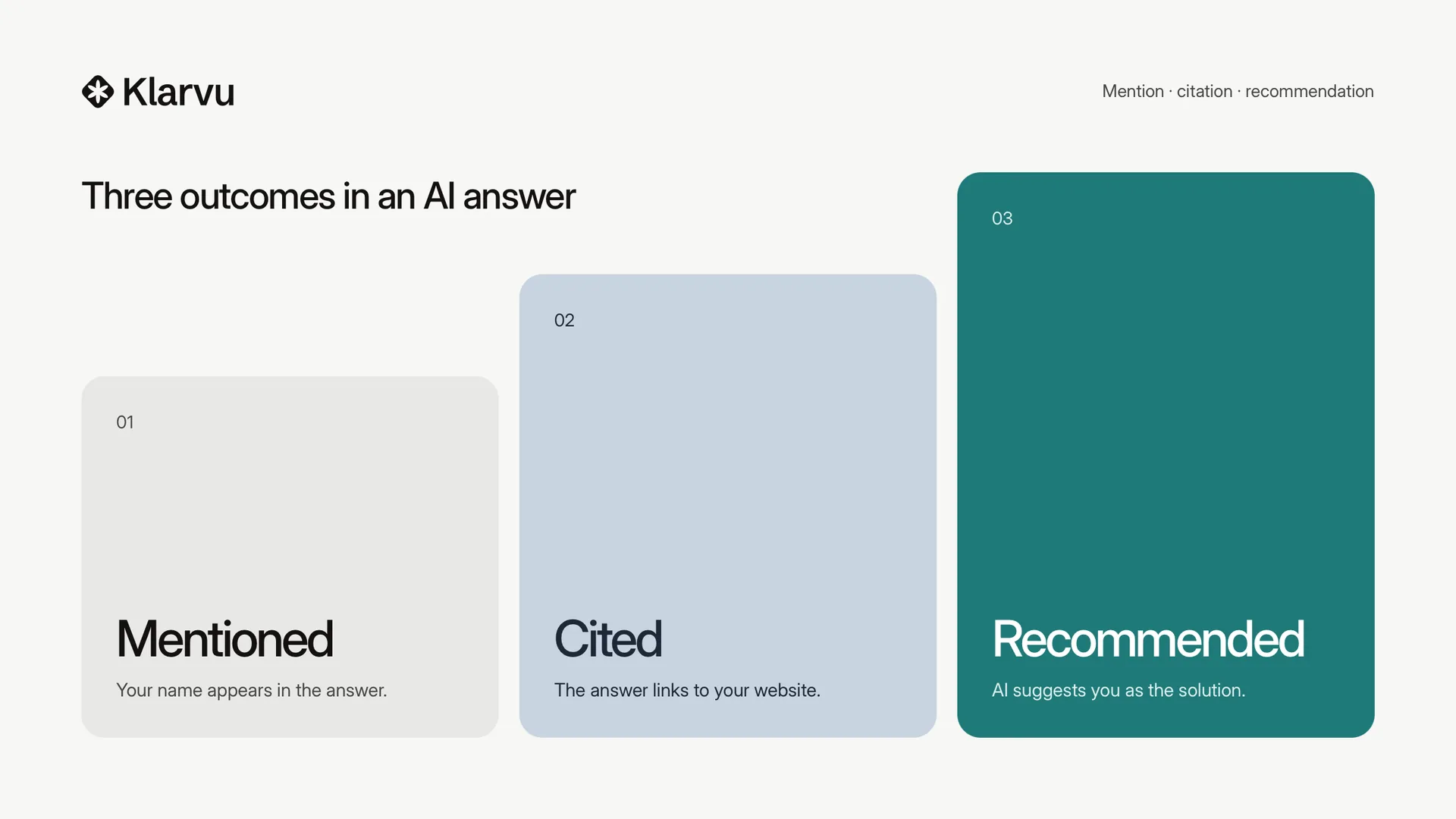
These outcomes can overlap, but they don't always.
ChatGPT might cite one of your blog articles without recommending your product. It might also recommend your company based on an independent comparison without linking to your website.
Neither outcome is automatically more valuable in every situation.
If your goal is attracting new customers, relevant recommendations may be particularly interesting. If you're trying to build authority and attract readers, citations might be equally valuable.
The point is to measure them separately.
A company mentioned frequently in AI answers isn't necessarily being recommended frequently. And a company receiving plenty of citations isn't necessarily appearing on buyers' shortlists.
Knowing the difference makes it much easier to understand what needs improving.
8 ways to improve your chances of being recommended by AI
There's no secret trick that makes every AI assistant recommend your business.
But there are eight practical areas you can work on. Some will look familiar if you've worked with SEO before. Others are more specific to the way people use AI to research and compare companies.
1. Find out what AI already says about your business
Before changing anything, find out where you stand.
Open ChatGPT, Gemini, Claude, or Perplexity and ask the kinds of questions your potential customers might actually use.
And importantly, don't just ask about your own brand.
If you run a software company, asking "What is [your company]?" might tell you whether an AI assistant recognizes the name.
It doesn't tell you whether someone who's never heard of you would receive your company as a recommendation.
For that, you need questions with genuine buying intent.
For example:
For local businesses:
- "Can you recommend an accountant for a small business in Copenhagen?"
- "Which physiotherapy clinics in Aarhus offer evening appointments?"
- "What are some good family-friendly hotels near central London?"
For B2B service companies:
- "Which consulting firms specialize in supply chain optimization?"
- "What agencies help European SaaS companies enter the US market?"
For software businesses:
- "What are the best AI visibility tools for a small marketing team?"
- "Which CRM integrates well with Microsoft 365 for a 15-person company?"
Start with 20–30 questions that reflect different customer needs, budgets, and stages of the buying process.
Then look at the answers.
Which companies appear? Which are actually recommended? Are the descriptions accurate? Which websites are cited?
You may find that your company appears for broad questions but disappears when someone asks about a more specific use case. Or that one competitor keeps appearing across several platforms.
That's useful information.
One important detail: AI answers aren't fixed search rankings. The same question can produce different answers over time or under different conditions.
So record the platform, date, language, location context, and exact question, where applicable. If possible, repeat the questions over multiple runs.
A single screenshot is an observation. It isn't a reliable visibility trend.
2. Make it obvious what your business actually does
This sounds almost too simple to deserve its own section.
But spend a few minutes reading company websites, and you'll notice how often businesses describe themselves without clearly explaining what they sell.
You encounter phrases like:
"We empower businesses through innovative, future-ready solutions."
That might sound impressive in a presentation. It doesn't tell a potential customer very much.
Now compare it with:
"We provide bookkeeping, payroll, and tax services for small businesses in Copenhagen."
The second version explains the service, the audience, and the location in one sentence.
It gives someone enough information to decide whether the company might be relevant.
The same principle applies to software.
A description such as "an intelligent platform transforming the future of digital marketing" provides very little useful detail.
Compare that with:
"Klarvu helps companies track when AI platforms mention, cite, and recommend their brands, and compare that visibility with competitors."
Much clearer.
Your website should make it easy to answer four questions:
- What do you actually offer?
- Who is it designed for?
- What problem does it solve?
- When would someone choose you instead of another option?
You don't need to put all four answers into one paragraph.
But they should be easy to find across your homepage, product pages, service descriptions, and other important content.
Be equally clear about limitations. If your software is designed for smaller teams, say so. If you only serve certain geographic areas, make that obvious.
Being specific won't make you relevant to everyone.
That's the idea.
You're trying to become a strong recommendation for the customers you can genuinely help.
3. Make sure AI can actually access your website
Before worrying about advanced GEO strategies, check something more basic.
Can the systems behind AI search actually access the information you've published?
Different AI platforms use different systems to discover and retrieve content.
For example, OpenAI distinguishes between two important crawlers:
- OAI-SearchBot is used to discover websites for ChatGPT's search features.
- GPTBot is associated with collecting content that may be used to train OpenAI's foundation models.
Those are different purposes, with separate controls.
OpenAI's crawler documentation explains the distinction.
Google, meanwhile, states that its existing SEO best practices remain relevant for AI Overviews and AI Mode.
So what should you check?
Start with the basics:
- Your most important public pages can be crawled and indexed by relevant search engines.
- Your robots.txt file doesn't accidentally block crawlers you want to allow.
- Your content isn't hidden behind login requirements or technical barriers.
- Product and service information is available as accessible text, not just inside images.
- Your website has sensible internal links, headings, canonical URLs, and a functioning sitemap.
- Your hosting provider, firewall, or bot protection isn't unintentionally blocking relevant crawlers.
- Your business information is accurate and current.
You should also consider structured data where it's appropriate.
Google supports formats such as Organization and LocalBusiness, which can help describe relevant information about a business.
But here's where I would be careful.
Adding schema markup isn't a magic switch that makes ChatGPT recommend your company.
Google explicitly says there are no special AI-specific markup requirements for appearing in its AI Search features.
Good technical foundations help make your information accessible. They don't guarantee that an AI assistant will choose you.
If you want to investigate this further, we've written a separate guide to AI crawlers and robots.txt.
4. Publish content that helps people make a decision
Think about the questions someone asks before choosing a company.
They probably want to know the price. Whether the product fits their needs. How it compares with alternatives. And what might go wrong.
Yet many business websites spend most of their space describing how good the company is.
That creates a gap.
If you're selling accounting services, a useful article might explain what a small business should look for when choosing an accountant.
If you're selling software, it might explain how to compare tools based on integrations, pricing, reporting capabilities, and company size.
The best content isn't necessarily the content that mentions your company most often.
It's the content that answers a real question properly.
A few particularly useful types of information include:
- Transparent pricing and explanations of what is included.
- Detailed product capabilities and limitations.
- Clear descriptions of intended customers and use cases.
- Honest comparisons between different approaches or products.
- Customer case studies with verifiable outcomes.
- Practical buying guides and answers to common objections.
Let's say you sell project management software.
Instead of publishing another general article about the importance of productivity, you could write:
"How to Choose Project Management Software for a 10-Person Consulting Team."
You could explain which features matter, how pricing changes with team size, when integrations become important, and what limitations buyers should watch for.
That helps an actual customer make a decision.
It also provides relevant, specific information that AI-assisted search may encounter when answering similar questions.
Google's guidance on helpful, reliable, people-first content supports the broader principle of creating useful material for readers rather than publishing content purely to attract search traffic.
There's another benefit here.
If you have original research, real product experience, or interesting data, use it.
An article based on something you've actually investigated has a better reason to exist than one that simply repeats what ten other websites already say.
5. Get mentioned in places other than your own website
Your website is where you explain your business.
But when someone is researching a purchase, they often want information from somewhere else too.
That might mean reviews, specialist publications, industry directories, product comparisons, professional associations, or discussions among people who've used the product.
AI-assisted search can draw on these kinds of sources as well.
And there is some interesting research suggesting just how relevant they can be in particular categories.
In September 2026, GEO company Cheers updated an analysis of 34,742 AI-generated answers across four platforms. The dataset covered home-services questions in 100 US and Canadian metropolitan areas, collected between August 31 and September 20.
Within the ChatGPT portion of its study, 84% of answers containing citations referenced at least one directory, review platform, or best-of list.
That's quite a striking number.
It does need some context, though.
This was an observational study by a commercial provider, focused on home services in North America. It doesn't establish that directories cause recommendations, and the results shouldn't be applied automatically to software, consulting, or other industries.
Still, it raises a useful question.
Which independent websites appear when AI recommends businesses in your industry?
You can read the Cheers research and methodology here.
For a local business, relevant sources might include local directories, professional associations, or review websites.
For a SaaS company, it might be independent comparisons, software review platforms, specialist publications, or genuine customer discussions.
The point isn't to get your company listed on every website you can find.
It's to understand which sources are relevant to your customers and earn a legitimate presence there.
One practical place to begin is with the citations you collected in step one.
Look at the sources AI assistants already reference for your category.
Are there reputable directories where your profile is missing? Independent publications covering your industry? Relevant comparison pages where your company would genuinely belong?
Those are much more interesting opportunities than buying a hundred low-quality backlinks or publishing artificial recommendations.
We've also written a more detailed guide to getting your brand mentioned by ChatGPT.
6. Build a reputation people can actually verify
Reviews are particularly important when people are comparing local businesses, but they're relevant in other industries too.
Think about choosing a hotel.
You probably want to know more than its location and room types. You want some indication of what previous guests experienced.
The same goes for software, professional services, and many other purchases.
Good reviews provide specific information.
Someone explaining that an accounting firm helped them handle payroll for their first employees is often more useful than a five-star rating with no explanation.
For software, a review describing how a product was used, what worked, and what was difficult can tell prospective customers whether it's suitable for them.
Different AI platforms may encounter and use review information differently. There is no publicly established universal weighting that tells us exactly how reviews influence every AI recommendation.
But giving people access to genuine customer feedback is valuable regardless.
Make it easy for customers to leave honest reviews on platforms relevant to your industry.
Don't manufacture them, selectively solicit only positive feedback, or offer incentives for favorable ratings. Google's review guidelines prohibit incentivized reviews.
And remember that reviews are only part of the picture.
A strong reputation begins with offering something worth recommending.
7. Focus on what matters for your type of business
A local plumber and a B2B software company shouldn't follow exactly the same AI visibility strategy.
They're recommended for different reasons.
Someone choosing a plumber probably cares about geography, availability, services, reputation, and whether the business can solve an urgent problem.
Someone choosing enterprise software may care more about integrations, security, technical capabilities, implementation requirements, and pricing.
That difference should shape the information you publish.
We saw this in our study of which banks AI recommends in Denmark. Danske Bank and AL Sydbank are recommended most often overall, but when the question is about investing, sustainability or digital banking, Saxo Bank, Merkur Andelskasse and Lunar are most often the first choice. AI recommends the bank that most clearly fits the need.
| Business type | What to prioritize |
|---|---|
| Local businesses | Accurate service areas, contact details, opening hours, legitimate business profiles, and genuine customer reviews. |
| B2B services | Specific expertise, industries served, credible case studies, qualifications, and examples of problems solved. |
| SaaS companies | Clear features, integrations, pricing, use cases, documentation, comparisons, and product limitations. |
| Ecommerce businesses | Accurate product specifications, current pricing and availability, shipping information, and clear return policies. |
For example, if you run a local accounting firm, make sure your services, location, and contact details are consistent wherever customers might find you.
If you sell software, explain exactly which workflows you support and who the product is designed for.
And if you operate an ecommerce store, keep product information updated. Outdated prices or incorrect stock information aren't particularly useful to anyone making a buying decision.
The common principle is simple: give people enough information to judge whether your business fits their needs.
What that information looks like will differ from one industry to another.
8. Track recommendations instead of relying on screenshots
This is where AI visibility starts becoming particularly interesting.
Suppose you make changes to your website, publish a useful comparison article, and earn a mention in a relevant industry publication.
How do you know whether any of it helped?
You could open ChatGPT, ask for a recommendation, and see whether your company appears.
But there's a problem.
One answer doesn't tell you much.
AI responses can vary based on the platform, the exact wording, available sources, time, language, geographic context, and other factors.
A better approach is to monitor a consistent set of questions over time.
I'd focus on four basic measurements.
| Metric | What it tells you |
|---|---|
| Mention rate | How often your company appears in the AI answers you're monitoring. |
| Recommendation rate | How often your company is presented as a suitable option in recommendation-intent answers. |
| Citation rate | How frequently the answers link to your website as a source. |
| Competitive visibility | Which competitors appear for the same questions and how your visibility compares. |
You can also go a step further and examine recommendation quality.
Imagine your software is designed for small marketing teams.
If ChatGPT recommends it to a multinational company seeking an enterprise-wide analytics platform, that may technically count as a recommendation.
But it's probably not a particularly useful one.
You want to understand whether AI is recommending your company for the right reasons.
A simple example
Let's say you collect 40 AI answers to relevant buying questions on one platform.
Your company is mentioned in 12 answers, recommended in eight, and accurately recommended for its intended use case in six.
That gives you:
- Mention rate: 12 out of 40 = 30%.
- Recommendation rate: 8 out of 40 = 20%.
- Qualified recommendation rate: 6 out of 40 = 15%.
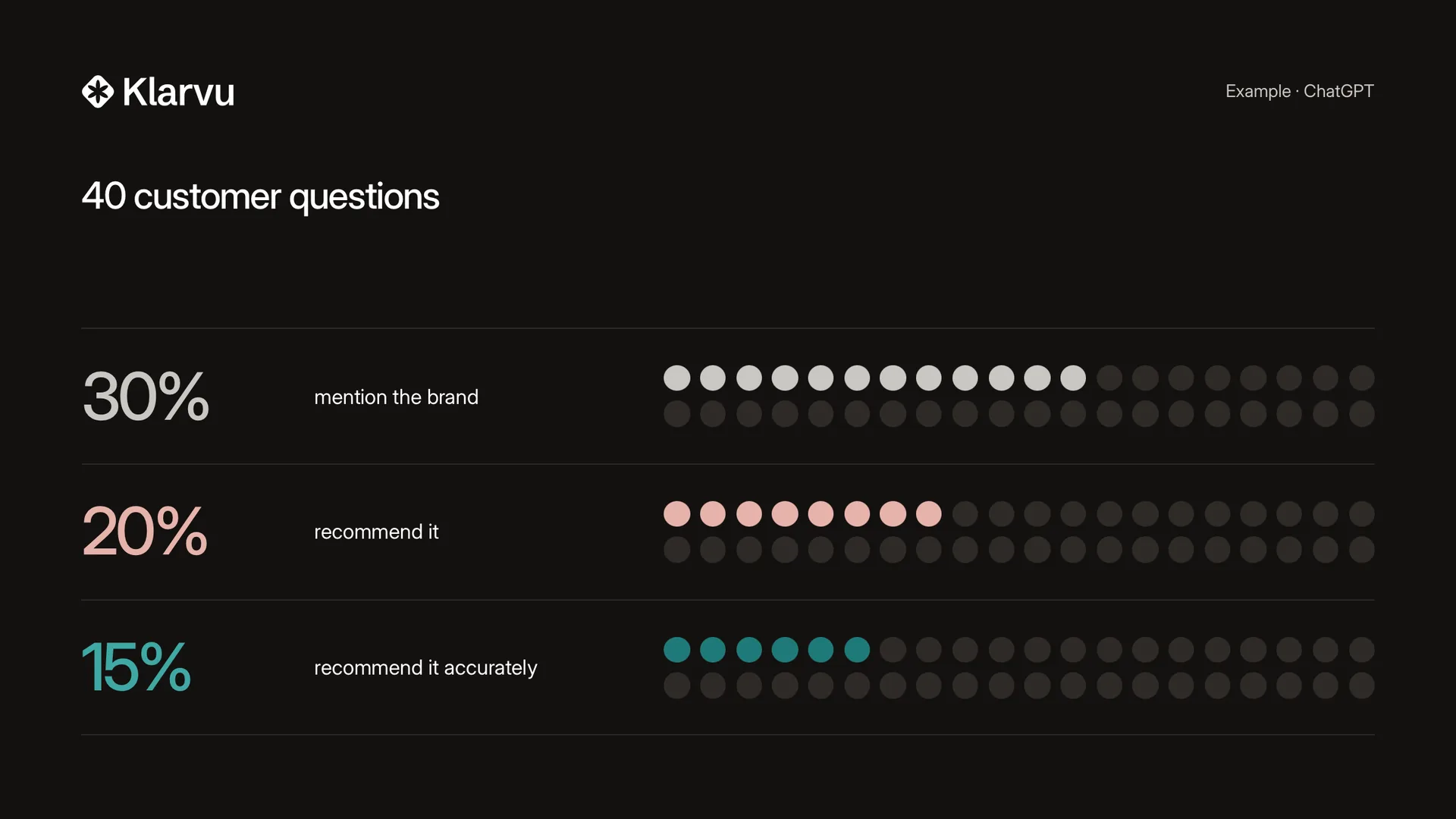
These numbers are hypothetical, purely to illustrate how the measurements work.
They aren't industry benchmarks.
Now repeat the same experiment regularly, keeping your questions and testing conditions as consistent as possible.
You can start identifying patterns.
Maybe your recommendation rate is improving. Maybe you're appearing more often for one customer segment than another. Or maybe a competitor is consistently recommended for a use case you haven't explained well enough on your website.
Those observations give you something concrete to investigate.
Just remember that changes in visibility don't automatically tell you what caused them. Platform updates, sampling variation, and changes in external sources can all influence the results.
This is the kind of monitoring Klarvu is designed to help with.
Klarvu tracks AI-generated mentions, citations, recommendations, and competitor visibility, making it easier to follow the same questions over time rather than relying on occasional manual checks.
The aim is to understand what's happening and decide what deserves attention next.
Why does ChatGPT recommend your competitors instead of you?
This is probably one of the most frustrating parts of AI search.
You know your company offers a good product. You know you can compete with the businesses being recommended.
Yet when someone asks ChatGPT for suggestions, your competitors appear and you don't.
So what's going on?
There are several possible explanations, and it's worth looking at them separately.
First, AI might not have enough information about your company.
Maybe your website uses broad descriptions, while competitors publish detailed information about their services, capabilities, pricing, and ideal customers.
That makes it harder to establish whether your business fits a specific request.
Second, your competitors might have stronger independent coverage.
Perhaps they appear in relevant industry articles, comparison websites, or directories that AI-assisted search frequently encounters.
That doesn't prove those sources caused the recommendation. But it's a reasonable place to investigate.
Third, your competitor might genuinely be a better fit.
This is easy to overlook.
Someone looking for affordable software for a five-person company may receive different recommendations from someone looking for an enterprise solution.
You shouldn't expect your business to appear for every possible version of a question.
And finally, the answer might simply vary.
AI assistants don't always generate identical recommendations, even when the question looks the same.
That's why I'd avoid making big strategic decisions based on one response.
Instead, compare the companies that appear repeatedly across a consistent set of relevant questions.
Look at how your business is described, which sources are cited, and whether your competitors provide information that's missing from your own website.
There's an important distinction here.
An AI assistant's explanation of why it recommended a company isn't necessarily a faithful account of its internal decision-making process.
Treat it as part of the answer you can analyze, not definitive proof of how the recommendation was selected.
A practical way to diagnose the problem
| What you notice | Where I'd investigate first |
|---|---|
| Your company never appears | Website discoverability, brand clarity, and relevant public information. |
| AI mentions you but recommends competitors | Product fit, comparisons, use cases, and independent evidence. |
| AI describes your company incorrectly | Outdated content, inconsistent business profiles, or unclear product information. |
| Your articles get cited but your product isn't recommended | Whether your product pages clearly explain capabilities and intended customers. |
| Recommendations change frequently | Question wording, platform differences, location, time, and normal answer variation. |
These aren't guaranteed diagnoses.
They're starting points for asking better questions.
And that's ultimately what makes systematic monitoring useful. Instead of guessing what you should improve, you can begin with the gaps you're actually observing.
Is getting recommended by AI different from traditional SEO?
Yes, although there's quite a bit of overlap.
Traditional SEO helps search engines discover, understand, and display your webpages.
AI visibility adds another question: when an AI assistant answers a potential customer's question, does it mention, cite, or recommend your company?
That changes what you need to measure.
| Traditional SEO | AI recommendation optimization |
|---|---|
| Track search rankings, impressions, and clicks. | Track mentions, citations, recommendations, and how accurately your business is described. |
| Research relevant keywords and search intent. | Also investigate conversational buying questions and customer decision criteria. |
| Optimize pages for discovery and relevance. | Make products, capabilities, and use cases easy to understand and compare. |
| Analyze competing webpages and search results. | Analyze recommended competitors and the sources appearing in AI answers. |
But I wouldn't treat SEO and AI visibility as competing disciplines.
In fact, many of the practical improvements overlap.
Clear content, accessible websites, accurate information, relevant external coverage, and strong technical foundations are useful for both.
Google's own guidance says that existing SEO best practices remain relevant for AI Overviews and AI Mode, without requiring additional AI-specific markup.
So you don't need to abandon traditional SEO or create a separate version of your website just for AI.
You need to understand how your visibility extends beyond the usual search results.
And that means measuring something beyond rankings and clicks.
A practical 30-day plan
If you're just getting started, I wouldn't recommend changing your entire marketing strategy at once.
A month is enough to establish a baseline, fix a few obvious issues, and begin measuring progress.
It isn't necessarily enough time to prove that your visibility has improved, but it's a sensible first step.
Week 1: Find out where you stand
- Choose 20–30 realistic customer questions.
- Test them across the platforms that matter to your audience.
- Record which brands appear, which are actually recommended, and which websites are cited.
Pay particular attention to questions where competitors repeatedly appear but your business doesn't.
Week 2: Fix the information you control
- Review your homepage, product pages, and service descriptions.
- Make sure it's clear what you offer, who you serve, and why someone might choose you.
- Check technical accessibility, indexing, and important business information.
If a prospective customer couldn't understand your offering from your website, that probably deserves attention before more advanced optimization work.
Week 3: Look beyond your own website
- Review the independent sources appearing in AI answers about your industry.
- Correct inaccurate listings and consider legitimate opportunities for industry coverage.
- Ask customers for genuine feedback through appropriate review channels.
If your website lacks a useful buying guide, comparison, or detailed use-case page, this is a good time to create one.
Week 4: Measure again
- Run your question set again under comparable conditions.
- Look at changes in mentions, citations, recommendations, and competitor visibility.
- Pay attention to how accurately AI describes your business, not just whether it appears.
Don't assume that any improvement was caused by one particular change. At this stage, you're building a monitoring process and identifying questions worth investigating further.
What you should have after 30 days
Ideally, you'll have a clearer picture of:
- Which customer questions you're visible for.
- Which competitors appear most often.
- Which sources AI platforms are using in your category.
- Where your public information is incomplete or unclear.
- Which improvements you want to test next.
That's already a much better position than making changes without knowing what AI currently says about your business.
Frequently asked questions
How can I make ChatGPT recommend my business?
Make it easy for ChatGPT to find accurate information about your company. Clearly explain your services, products, customers, and relevant strengths. Check that your public pages are accessible to appropriate search crawlers, and build credible independent coverage and genuine customer reviews. Then monitor realistic customer questions to see whether ChatGPT recommends your company. There is no guaranteed placement method.
Can I pay ChatGPT to recommend my company?
You cannot pay to guarantee a place in ChatGPT's organic recommendations. OpenAI has introduced advertising in ChatGPT, but states that ads are separate from and do not influence its answers. Be cautious of agencies or services promising guaranteed organic recommendations or specific AI rankings.
How do I get AI to recommend my local business?
Start with accurate information about your location, services, opening hours, and contact details. Keep relevant business profiles updated, encourage genuine customer reviews, and make sure your website clearly explains which services you offer and where. Then test location-specific questions across relevant AI platforms.
Do customer reviews affect AI recommendations?
Reviews can provide relevant information about customer experiences, reputation, and suitability. Their influence will depend on the AI platform, available sources, and the question being asked. There is no universal public formula showing exactly how much reviews influence AI recommendations. Focus on genuine feedback rather than trying to manipulate ratings.
Does schema markup help AI recommend my business?
Structured data can help search engines interpret information about a company, webpage, or product. But adding schema markup doesn't automatically make an AI assistant recommend you. Use appropriate structured data as part of good technical SEO, alongside clear and useful website content.
How long does it take to appear in AI recommendations?
There isn't a reliable universal timeframe. Some changes may become visible as search systems retrieve updated information. Others may take longer, depending on the platform, indexing, available sources, and other factors. Monitor results over time rather than expecting an immediate response after updating a page.
What if my business is new and has very few online mentions?
Start by getting the fundamentals right. Publish clear information about your business, create complete and accurate profiles on relevant platforms, and build legitimate customer feedback as your business grows. You don't need to appear everywhere. Focus on being accurately represented in the places that matter to your audience.
What is the difference between being cited and recommended by AI?
A citation means an AI response references your website or another source. A recommendation means the assistant suggests your company as a possible solution to someone's needs. Your website can be cited without your company being recommended, and your company can be recommended without a citation to your own website. Both are worth measuring, but they tell you different things.
How can I track which AI platforms recommend my business?
Create a consistent set of questions your potential customers might ask. Run those questions across ChatGPT, Gemini, Claude, Perplexity, and other relevant AI search experiences. Record mentions, citations, recommendations, competitors, and the accuracy of each answer. You can do this manually for a small question set, or use an AI visibility monitoring platform like Klarvu to collect and compare results more systematically.
The real goal isn't to appear in every answer
There's something worth remembering when working on AI recommendations.
Your company probably shouldn't be recommended to everyone.
A small accounting firm shouldn't necessarily appear when someone asks for complex international tax advice. A lightweight software product shouldn't automatically be recommended to a company looking for a full enterprise system.
The goal is to be recommended when your business is genuinely a good fit.
And to get there, you need to understand two things: what information is available about your company, and how AI systems currently present that information to potential customers.
Make your offering clear. Give customers useful information. Build a reputation supported by real evidence.
Then look at the answers.
Because until you know when AI recommends you, when it doesn't, and who appears instead, you're mostly guessing about what to improve.
And that's probably the most useful place to start.
Further reading and sources
Official guidance
- OpenAI: Searching the web with ChatGPT
- OpenAI: Overview of OpenAI crawlers
- OpenAI: Testing ads in ChatGPT
- Google Search Central: AI features and your website
- Google Search Central: Creating helpful, reliable, people-first content
- Google Search Central: Organization structured data
- Google Search Central: LocalBusiness structured data
- Google Business Profile Help: Tips to get more reviews
Independent research
- Cheers: How to Get ChatGPT (and Other AI) to Recommend Your Business — observational research covering 34,742 AI answers to home-services questions, August–September 2026.
More from Klarvu