How to Get Your Brand Cited in ChatGPT (2026 Guide)
Short answer
To get your website cited in ChatGPT, start by making sure OAI-SearchBot can access your public content. Publish clear, accurate information that answers questions your customers ask, support important claims with evidence, and build a credible presence beyond your own website. Then investigate which sources ChatGPT uses for relevant questions and monitor when your business is mentioned, cited, or recommended.
There is no guaranteed way to earn a citation. ChatGPT doesn't search the web for every question, and being cited isn't the same as being recommended.
Imagine someone asks ChatGPT:
"What's the best project management software for a small consulting firm?"
ChatGPT recommends four platforms. Your competitor appears near the top. Your company isn't mentioned.
You open the sources and discover something interesting: ChatGPT has cited an independent comparison of project management tools, but not your website.
Your product offers several of the features the user asked for. So why didn't it appear?
There are several possible explanations. Maybe your product wasn't included in the comparison. Maybe its capabilities aren't documented clearly enough. Maybe another platform genuinely fits the user's needs better.
Or perhaps ChatGPT answered without retrieving the information you recently published.
These situations require different responses.
OpenAI has documented how ChatGPT searches the web, which crawlers website owners can control, and how product information contributes to certain shopping results. But it hasn't published a complete formula for deciding which companies to recommend or which webpages to cite.
That leaves a more useful approach than guessing at ranking factors: investigate the answers, understand which sources are being used, and improve the information that's available.
How ChatGPT finds information and cites websites
ChatGPT can answer questions using information available to its models. It can also search the web when current or additional information would be useful.
According to OpenAI's official ChatGPT Search documentation, ChatGPT may search automatically when a question would benefit from current information. Users can also select Search to request a web search directly.
That distinction matters.
Ask ChatGPT to explain a familiar accounting concept, and it may answer without retrieving new information.
Ask which accounting platforms currently support a particular integration, and up-to-date information becomes more relevant.
When ChatGPT searches the web, it can include citations linking to supporting sources. Users can open those citations and, where available, explore additional source links through the Sources interface.
But not every answer uses live search. And not every answer contains citations.
ChatGPT can turn one question into several searches
There's another interesting detail in OpenAI's documentation.
ChatGPT Search can work with third-party search providers. When it does, it may rewrite a user's question into one or more targeted search queries.
If the initial results aren't sufficient, it can make additional searches.
Consider someone asking:
"Which AI visibility platforms can track recommendations across ChatGPT, Gemini, and Claude for a Danish marketing team?"
The underlying information needs might include supported platforms, language coverage, product capabilities, pricing, and suitability for a smaller organization.
OpenAI hasn't published the exact searches that would be performed for this example. But its documentation confirms that query rewriting and follow-up searches are part of the search process.
This helps explain an important point.
Your website doesn't necessarily need to contain the exact wording of a user's question. It needs useful information relevant to the underlying needs.
It also explains why a page about one specific product capability might be cited in response to a broader comparison question.
Still, appearing in a search result isn't the same as being selected as a citation.
OpenAI says ChatGPT ranks search results using multiple factors intended to help users find relevant, reliable information. It doesn't disclose a complete ranking formula or guarantee placement.
Does ChatGPT use Google or Bing?
ChatGPT Search can work with external search providers, but it doesn't simply reproduce a Google or Bing results page.
OpenAI's documentation describes partnerships with other search providers, query rewriting, and additional searches when appropriate.
That makes conventional search discoverability relevant.
But ranking first on Google doesn't guarantee that ChatGPT will cite your website. And there is no publicly documented rule requiring a webpage to hold a particular Google or Bing ranking before ChatGPT can reference it.
The better question is what ChatGPT actually retrieves and uses for the questions that matter to your business.
A citation, a mention, and a recommendation aren't the same thing
Before improving your visibility, it's worth defining what you're trying to achieve.
Suppose a user asks:
"Which tools can help a marketing team monitor AI-generated brand recommendations?"
Your company could appear in three different ways.
| Visibility type | What it means |
|---|---|
| Brand mention | ChatGPT names your company or product. |
| Website citation | ChatGPT links to a webpage on your domain as a supporting source. |
| Brand recommendation | ChatGPT suggests your business as a suitable option for the user's needs. |
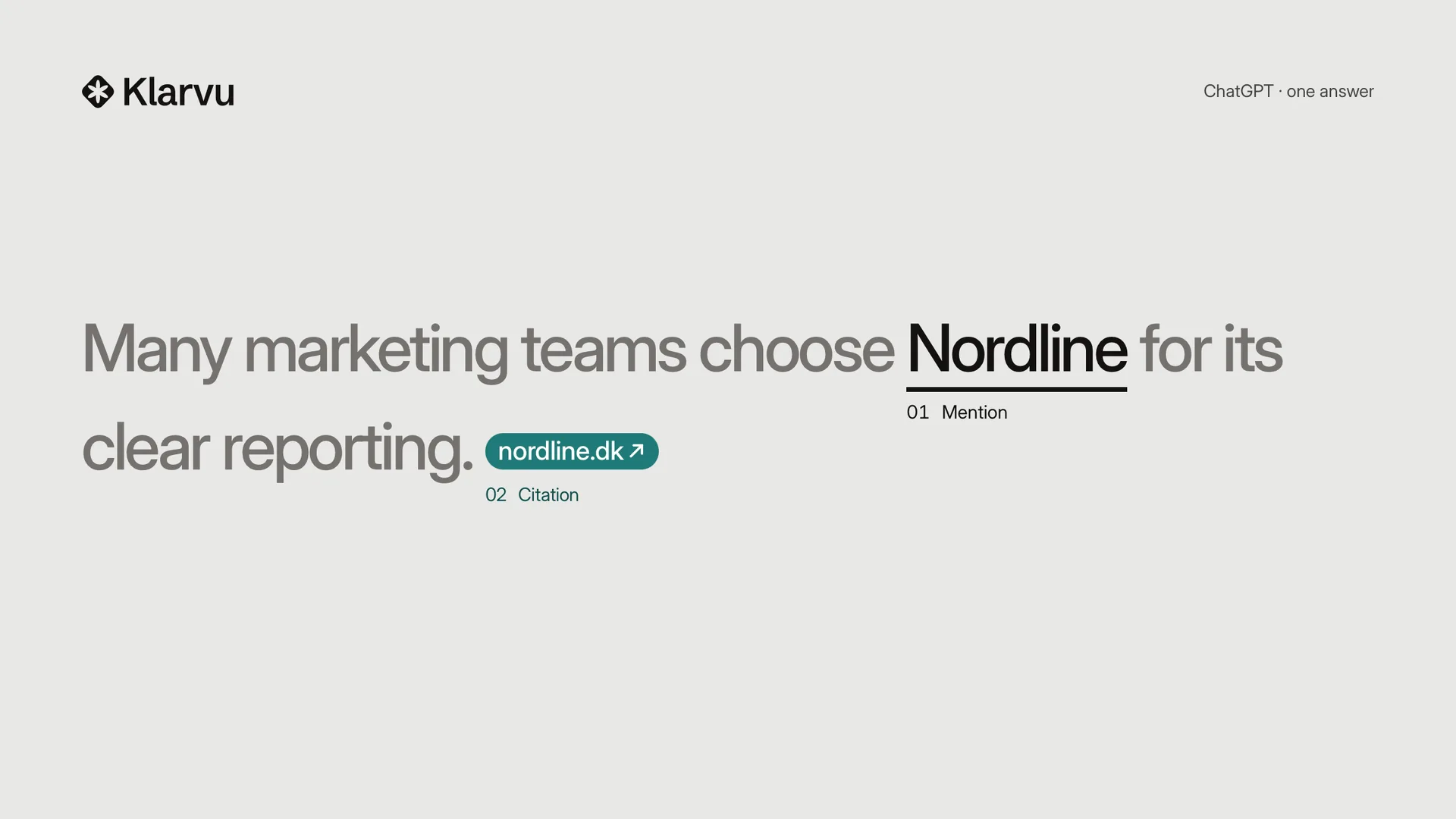
These outcomes often overlap, but they don't have to.
ChatGPT might cite a helpful article from your website while recommending competing software.
Or it might recommend your company using information from an independent review without directly citing your own domain.
One result indicates that your content was used as a source. The other indicates that your business was presented as a relevant choice.
For most companies, both are worth understanding. Our guide on how to get AI to recommend your business goes deeper into the recommendation side.
There's also a fourth outcome worth separating: product visibility.
When someone asks ChatGPT about buying a physical product, they may see product cards, prices, merchant links, and other shopping-specific information. These don't necessarily work like ordinary editorial citations.
We'll return to that distinction later.
7 practical ways to improve your visibility in ChatGPT
There isn't an official checklist that guarantees placement in ChatGPT.
But OpenAI has published enough documentation to identify some concrete technical requirements. And there are useful ways to investigate the information ChatGPT references.
Here are seven places to start.
1. Make sure ChatGPT Search can access your website
Before rewriting your content, check that ChatGPT Search can discover it.
OpenAI operates different crawlers and user agents for different purposes.
| Agent | What it does |
|---|---|
| OAI-SearchBot | Helps websites appear in ChatGPT Search results. |
| GPTBot | Crawls content that may be used to train OpenAI's foundation models. |
| ChatGPT-User | Retrieves webpages during certain user-initiated interactions. |
These distinctions are important.
If your objective is to appear in ChatGPT Search, OAI-SearchBot is the relevant crawler.
You can explicitly allow it in your site's robots.txt file:
User-agent: OAI-SearchBot
Allow: /
This example permits OAI-SearchBot to crawl the entire site under that rule. Your actual robots.txt configuration may have additional requirements.
OpenAI also allows website owners to manage search crawling and training-related crawling independently.
For example, a publisher could allow OAI-SearchBot while separately blocking GPTBot:
User-agent: OAI-SearchBot
Allow: /

User-agent: GPTBot
Disallow: /
Allowing GPTBot isn't required for inclusion in ChatGPT Search.
There are some further details worth checking.
Your firewall may be blocking legitimate crawler requests.
Even if robots.txt permits access, a CDN or security service could reject requests from OAI-SearchBot.
OpenAI recommends allowing requests from its published search crawler IP ranges.
Check your server logs and firewall rules for blocked requests. A 403 Forbidden response or an authentication requirement can prevent access.
Your content needs to be retrievable.
Important public information should be available in the HTML served by your website. Server-side rendering or static generation can help with websites that otherwise rely heavily on browser-side JavaScript.
ChatGPT-User works differently.
OpenAI explains that ChatGPT-User is associated with certain user-initiated webpage visits. It isn't the crawler that determines automatic ChatGPT Search inclusion, and robots.txt restrictions may not apply in the same way to those user requests.
Blocking OAI-SearchBot is not identical to making every link disappear.
OpenAI notes that sites opting out of OAI-SearchBot aren't shown as normal sources in ChatGPT Search answers, although navigational links can still appear in some circumstances.
Finally, changes to crawler permissions may take approximately 24 hours to be reflected in OpenAI's systems.
That doesn't mean your website will be cited within 24 hours.
The practical audit is simple: check crawler permissions, firewall access, and whether your important pages contain readable information.
For additional details, see OpenAI's official crawler documentation. Our AI crawlers and robots.txt guide compares OpenAI's crawlers with those of the other AI platforms.
2. Investigate the questions your customers actually ask
One of the most useful things you can do is stop thinking exclusively in terms of individual keywords.
Imagine you're selling accounting software.
A customer might ask ChatGPT:
- "What's the best accounting software for a Danish startup?"
- "Which accounting platforms support multiple currencies?"
- "What are the alternatives to Dinero for a growing company?"
- "Which accounting system is easiest to integrate with our CRM?"
All four questions concern accounting software, but they describe different needs.
Your company might be suitable for one and less relevant for another.
That's important because AI-assisted buying research can become a conversation.
A user might begin with a broad question, narrow the results to a budget, ask about integrations, and eventually request a recommendation.
Your visibility can change throughout that process.
Start by collecting questions from actual customer conversations, support requests, sales meetings, and product research.
Then group them by purpose.
| Question type | Example | What to investigate |
|---|---|---|
| Informational | "How does multicurrency accounting work?" | Which explanations and sources ChatGPT uses. |
| Comparison | "How does Product A compare with Product B?" | Whether your product is described accurately. |
| Recommendation | "Which accounting software should we choose?" | Which companies ChatGPT recommends and why. |
| Decision-oriented | "Which option fits a team of 12 with a limited budget?" | Whether your product meets the stated requirements. |
Test these questions in ChatGPT and examine the answers.
Which brands appear? Which websites are cited? What does ChatGPT say about your company's strengths and limitations?
Avoid making your entire test set consist of branded questions.
If you ask "What is Klarvu?" you're measuring something very different from asking "What are the best AI visibility platforms for Danish businesses?"
Both have value, but they shouldn't be mixed without distinguishing their purpose.
And don't create a separate article for every slight variation of a question.
Build resources around genuine customer needs. The objective is to answer questions well, not to produce hundreds of nearly identical pages.
3. Give ChatGPT useful facts about your business
A common problem with company websites is that they describe their positioning more clearly than their actual offering.
Imagine a software company says it provides an intelligent platform that transforms modern workflows.
That tells a potential customer very little.
Does it support Microsoft Teams? Can it export reports? How is pricing calculated? What type of organization is it designed for?
Now consider a potential customer asking ChatGPT:
"Which reporting platforms can automatically export monthly dashboards to Excel?"
A product page explaining supported export formats, report scheduling, and subscription limitations contains useful information for that question.
A vague marketing statement doesn't.
This is particularly important for product comparisons.
When people ask ChatGPT which company to choose, relevant criteria might include pricing, supported features, integrations, geographical availability, and the type of customer the product serves.
Make those details easy to find on your website.
For software, that means clear product documentation.
For professional services, it means explaining your specialisms, experience, services, and who you work with.
For physical products, it means accurate specifications, prices, and availability.
Be transparent about limitations too.
A product isn't necessarily the best fit for every customer. Explaining where it works well, and where it doesn't, helps people make better decisions.
You don't need to format every paragraph as a short answer or create artificial AI-only content blocks.
OpenAI hasn't published a preferred paragraph length or a required content structure for ChatGPT citations.
Write clearly because the information is worth understanding, not because someone claims a particular writing template guarantees AI visibility.
4. Publish information worth referencing
There's already an enormous amount of content explaining SEO, AI search, marketing, and product selection.
Much of it repeats advice that can be found on dozens of other websites.
Original research offers a different opportunity.
Consider two articles.
The first explains that AI assistants are changing how customers discover software.
The second investigates how frequently ChatGPT, Gemini, Claude, and Perplexity recommend the same software companies in response to a defined set of questions.
The second article provides something a reader can examine and potentially reference.
The same principle applies across industries.
A logistics company could publish original analysis of shipping capacity. A cybersecurity firm might share research into emerging threats. A software company could publish a transparent benchmark comparing different technical approaches.
The research doesn't have to be enormous.
It needs to answer an interesting question and explain how the answer was established.
If you're publishing original research, include the sample size, collection dates, methodology, and relevant limitations.
If the research involves AI-generated answers, document the prompts, models, settings, and testing conditions.
The academic paper GEO: Generative Engine Optimization, presented at KDD 2024, examined how modifying source content could influence visibility in experimental generative search environments.
Its results offer useful background on generative search, but they aren't evidence that one particular change guarantees ChatGPT citations.
And original research shouldn't be a label applied to ordinary opinion pieces.
If you claim to have discovered a pattern, readers should be able to understand the observations behind it.
That is what makes research worth referencing.
5. Study the websites ChatGPT already cites
Your website is only one part of the information available about your business.
ChatGPT may reference official product pages, independent comparisons, specialist publications, research reports, reviews, or community discussions when answering a question.
Instead of guessing where you should seek more visibility, examine the sources that actually appear.
Imagine you sell HR software.
You test 30 questions about performance management tools, employee engagement platforms, and HR software for growing companies.
For each response that uses search, you record the cited URLs.
Then you group them by source type.
| Source type | What to investigate |
|---|---|
| Company websites | Which competitors are cited directly, and what information do they provide? |
| Independent comparisons | Does your product appear alongside relevant alternatives? |
| Industry publications | Which companies and topics receive independent coverage? |
| Review platforms | Are the descriptions current and based on genuine customer experiences? |
| Community discussions | What do users repeatedly praise, question, or criticize? |
| Research reports | Which original findings support the answers? |
This is a suggested method, not the result of a completed Klarvu study.
Once you've collected enough answers, you may discover some patterns.
Perhaps ChatGPT regularly cites a comparison site where your product is missing.
Perhaps a relevant publication includes your competitors but doesn't mention your research.
Or perhaps your company's own documentation doesn't address the requirements that repeatedly appear in customers' questions.
These findings can guide your next steps.
You might update product information, correct an inaccurate directory listing, or provide original evidence that a journalist or analyst would find useful.
But don't confuse third-party credibility with manufacturing brand mentions.
Fake reviews, artificial forum recommendations, and misleading paid endorsements don't create a trustworthy understanding of your business.
One more distinction matters: if a competitor appears more often than you, it doesn't necessarily mean your marketing is failing.
The competitor may genuinely be better suited to the question.
The purpose of source analysis is to understand why certain businesses appear and decide what, if anything, you should improve.
6. Understand how ChatGPT handles products and shopping results
ChatGPT visibility doesn't always look like a traditional text answer with source links.
When a user expresses shopping intent, ChatGPT can present products with images, descriptions, prices, reviews, merchant information, and links to product pages.
For some products, users may also see checkout options.
OpenAI has documented how these shopping experiences work.
According to its shopping documentation, product selection can take account of the user's question and context, structured product metadata, third-party content, and other available information.
That has a practical implication for retailers.
If you're selling physical products, accurate product feeds and structured catalog information can be particularly important.
Product titles, descriptions, specifications, prices, and availability should reflect what customers can actually buy.
OpenAI has also introduced product discovery integrations based on the Agentic Commerce Protocol, or ACP.
Its documentation explains that product feeds help ChatGPT understand product catalogs and display more complete information. Direct feed onboarding is currently available to approved partners.
But shopping visibility is not the same as receiving a website citation in an editorial answer.
A product card appearing in a shopping experience should be measured separately from an article being cited as a source.
It's also important to distinguish product results from advertising.
OpenAI states that product results are selected independently of ads and aren't influenced by advertiser partnerships. Ads are presented separately and don't determine ChatGPT's answers.
For a B2B software company, the practical focus may still be accurate product documentation and independent comparisons.
For an online retailer, catalog data, product availability, and merchant information may require additional attention.
Different businesses need different approaches.
7. Measure mentions, citations, and recommendations separately
Once you've improved your website and investigated the relevant sources, you need to know what's happening in the actual answers.
This is where many AI visibility strategies become difficult to evaluate.
Someone checks a few prompts, sees their company mentioned once, makes some website changes, and checks again a week later.
But ChatGPT responses can vary between runs.
The same question might produce a different shortlist, use different sources, or be answered without live web search.
That's why repeatable measurement matters.
Start with a defined group of questions relevant to your business.
Test them under comparable conditions and record both the answers and the sources.
Four metrics are particularly useful.
| Metric | How to calculate it |
|---|---|
| Mention rate | Answers mentioning your brand ÷ all relevant answers tested |
| Overall website citation rate | Answers citing your website ÷ all relevant answers tested |
| Search-conditioned citation rate | Search-based answers citing your website ÷ search-based answers tested |
| Recommendation rate | Eligible recommendation answers suggesting your brand ÷ eligible recommendation answers tested |
Let's take a hypothetical example.
You collect 60 ChatGPT answers.
- 18 mention your company.
- 36 use live web search.
- 9 cite your website.
- 24 ask for relevant product recommendations.
- 6 of those 24 recommend your company.
That produces the following results:
| Metric | Result |
|---|---|
| Mention rate | 30% |
| Overall website citation rate | 15% |
| Search-conditioned citation rate | 25% |
| Recommendation rate | 25% |
| Search usage rate | 60% |
These are illustrative numbers, not findings from Klarvu's own dataset.
The distinction between overall citation rate and search-conditioned citation rate is particularly useful.
A company may receive few citations partly because ChatGPT rarely searches for its target questions.
Another company may appear in many search-based answers but still receive few direct citations.
Those are different situations.
It's also worth examining your competitors' visibility, the types of sources being cited, and whether ChatGPT describes your product correctly.
For reliable comparisons, document which model and search mode you used, when the tests were run, and relevant language, country, and personalization settings.
ChatGPT can use location and relevant personalization context in certain search and recommendation experiences. A question from one user isn't necessarily answered in exactly the same way for another.
Avoid assuming that a change in visibility was caused by a particular website update. Model updates, source changes, and normal answer variability can all affect the results.
At Klarvu, we help businesses monitor brand mentions, citations, recommendations, and competing brands across AI platforms, including ChatGPT.
That makes it easier to move beyond individual spot checks and identify patterns across relevant questions over time.
Why ChatGPT might recommend your competitors instead of you
Not appearing in an answer doesn't automatically mean there's something wrong with your SEO.
Different patterns suggest different questions worth investigating.
| What you observe | What to examine |
|---|---|
| ChatGPT mentions your business but rarely recommends it | Whether your offering fits the requirements in the tested questions. |
| Your articles are cited, but your product isn't recommended | Whether ChatGPT can find accurate product information and independent evidence about your company. |
| Competitors receive direct website citations | Which pages and facts those citations support. |
| Independent comparison sites dominate the sources | Whether your business is accurately represented in those publications. |
| ChatGPT describes your product incorrectly | Whether outdated or contradictory information is publicly available. |
| ChatGPT doesn't use live web search | Whether citation visibility is an appropriate metric for that particular question. |
These are starting points, not definitive diagnoses.
The more useful approach is to examine the user's actual question, the answer, the cited sources, and what a good recommendation would need to consider.
Sometimes the right next step is better content.
Sometimes it's technical accessibility or correcting outdated information elsewhere.
And sometimes your product simply isn't the strongest choice for that particular customer.
That's useful to know too.
Is ChatGPT SEO different from traditional SEO?
There is substantial overlap.
A technically accessible website, accurate information, useful content, and credible references can support both traditional search and ChatGPT discovery.
But the experience of finding information is different.
A traditional search engine typically presents a collection of links for the user to explore.
ChatGPT can synthesize information, compare options, explain tradeoffs, and recommend businesses within a conversation.
That changes what needs to be measured.
| Traditional SEO | ChatGPT visibility |
|---|---|
| Rankings and search impressions | Presence in relevant AI-generated answers |
| Organic clicks | Citations, mentions, recommendations, and attributable referral traffic |
| Competing search-result pages | Competing businesses and cited sources |
| Search queries | Conversational questions and follow-up requirements |
| Website performance | How the business is described and evaluated in answers |
These are complementary, not competing disciplines.
Your conventional SEO work still helps users and search systems discover your content.
But Search Console or Bing Webmaster Tools won't give you a complete record of how ChatGPT recommends your business.
You need to examine the answers themselves.
For more background, see our guide to AI visibility and GEO.
A practical 30-day plan to investigate your ChatGPT visibility
You don't need to rewrite your entire website to begin.
Start with a small, measurable investigation.
| Week | What to do | What you'll have afterward |
|---|---|---|
| Week 1 | Check OAI-SearchBot access, firewall rules, and important public pages. Test a fixed set of relevant ChatGPT questions. | A technical audit and initial visibility baseline. |
| Week 2 | Review the website pages most relevant to those questions. Improve missing capabilities, product descriptions, and evidence. | Updated content and a clear record of what changed. |
| Week 3 | Analyze cited domains, competitors, and third-party sources. Identify one worthwhile original research or documentation opportunity. | A prioritized list of source and content gaps. |
| Week 4 | Repeat the same tests under comparable conditions. Review mentions, citations, recommendations, and search usage. | An initial comparison and a more informed plan for the next month. |
Treat this as an investigation rather than a promise of results.
Even if your website improves substantially, ChatGPT may not cite the updated content immediately.
OpenAI doesn't provide a universal timeline for earning citations.
The important thing is to establish a baseline, make deliberate changes, and monitor what happens over time.
Frequently asked questions
How do I get my website cited in ChatGPT?
Make sure OAI-SearchBot can access your public content, publish relevant and well-supported information, and investigate which sources ChatGPT uses when answering questions in your industry. Keep your company information accurate across your website and relevant independent sources, and monitor your visibility over time. There is no guaranteed method for earning citations.
Does ChatGPT always search the web before answering?
No. ChatGPT can answer using information available to its models. It may search automatically when current information would be useful, and users can also request web search directly. Answers without live search generally don't provide citations to newly retrieved webpages.
Does ChatGPT use Google or Bing to find websites?
ChatGPT Search can work with third-party search providers and may rewrite a question into several targeted searches. OpenAI doesn't publicly describe a universal formula that simply copies Google or Bing rankings. Ranking well in traditional search may support discoverability, but it doesn't guarantee inclusion in ChatGPT's answers.
Do I need to allow GPTBot to get cited?
No. GPTBot is related to potential foundation-model training, while OAI-SearchBot supports ChatGPT Search. Website owners can allow one and restrict the other.
How long does it take for ChatGPT to discover a website?
There isn't a guaranteed timeframe. OpenAI says changes to OAI-SearchBot permissions can take approximately 24 hours to be reflected in its systems, but this doesn't mean a page will be indexed, selected, or cited within a day.
Does structured data help ChatGPT citations?
Structured information can help make product and business details clearer and is used in certain ChatGPT shopping experiences. However, OpenAI hasn't published a general schema.org requirement that guarantees citations in ChatGPT Search. Use relevant structured data accurately, but don't treat it as a shortcut to citation placement.
Can I pay to appear in ChatGPT recommendations?
Advertising and organic recommendations are separate. OpenAI states that ads don't influence the answers ChatGPT generates, and product results are selected independently of advertiser partnerships. Paying for an ad doesn't guarantee organic citations or recommendations.
How can I measure ChatGPT citations?
Start with a repeatable set of questions. Record the full answers, cited URLs, brand mentions, and recommendations, along with model, date, search mode, and relevant settings. Calculate citation and mention rates separately, and use only eligible recommendation questions to calculate recommendation rate. Repeat the process to understand patterns rather than relying on a single answer.
Why does ChatGPT mention my company without linking to my website?
ChatGPT may be using information available to the model or sources that aren't directly linked to your domain. A brand mention doesn't prove that your website was retrieved during that answer. Likewise, a website citation doesn't mean the brand was recommended.
Start with the answers your customers are already getting
Choose ten questions a serious buyer in your industry might ask ChatGPT.
Look at the responses carefully.
Which companies are recommended? Which websites provide the supporting information? Does ChatGPT describe your business accurately? And did it actually search the web?
Then compare those findings with the information on your website and the independent sources your customers use.
You may discover that your next opportunity isn't another blog article.
It could be clearer product documentation, an outdated directory listing, a technical crawler issue, or an original piece of research that answers a question nobody has investigated properly.
The important part is knowing which problem you're trying to solve.
That's where a useful ChatGPT visibility strategy begins.
To compare how the other platforms work, read our guides to getting cited in Claude, Gemini, and Perplexity.