How to Get Your Brand Cited in Perplexity (2026 Guide)
Short answer
To get your website cited in Perplexity, make sure its search crawlers can access your content, publish clear and useful information that answers relevant questions, and investigate which sources Perplexity already references in your industry. Original research, accurate product information, and credible third-party coverage can all give your website something valuable to contribute. Track citations alongside brand mentions and recommendations to understand where you're gaining visibility and where you're missing.
There's no guaranteed way to earn a citation. But Perplexity has published enough about its search infrastructure to give us a useful starting point.
A company can publish the most detailed guide in its industry and still watch Perplexity cite a competitor's website instead.
Sometimes the competitor has better information. Sometimes an independent comparison is more relevant to the question. And sometimes your own website simply isn't among the sources the search system retrieves.
Understanding the difference is important.
Perplexity has shared unusually detailed information about how its search technology works. Its infrastructure combines traditional keyword matching with semantic search, evaluates individual passages within webpages, and uses multiple ranking stages to identify relevant information.
That gives us something more useful to work with than another list of supposed AI ranking factors.
In this guide, we'll look at what Perplexity has actually documented, what remains uncertain, and how you can investigate and improve your website's chances of being cited.
How Perplexity finds and selects web sources
Perplexity is an AI-powered answer engine that retrieves information from the web and uses language models to produce answers supported by source links.
But what happens between a user asking a question and Perplexity displaying an answer?
In September 2025, Perplexity published a technical article titled Architecting and Evaluating an AI-First Search API.
It offers an interesting look at the infrastructure behind its search technology.
At the time of publication, Perplexity reported that its search index tracked more than 200 billion unique URLs and that its production search infrastructure processed around 200 million daily queries.
The more interesting part, however, is how the system handles information.
Perplexity combines keyword and semantic search
Traditional keyword matching looks for documents containing relevant words and phrases.
Semantic search attempts to identify information based on meaning, even when a page doesn't use exactly the same wording as the question.
Perplexity's documented Search API architecture uses both approaches.
Imagine someone searching for:
"Which accounting platforms support international payments for small businesses?"
A keyword-based system might look for pages containing phrases such as "accounting software" and "international payments."
Semantic retrieval can also help identify relevant pages discussing multicurrency accounting, cross-border transactions, or foreign exchange support.
The system combines candidate results from these approaches before further filtering and ranking.
For website owners, the practical lesson is fairly straightforward.
Use the words your customers actually use, but don't write pages solely to repeat keywords. Explain the underlying subject clearly enough that your content is relevant to different ways of asking about it.
Individual passages matter
Perplexity's technical article also describes an important difference between AI-oriented retrieval and traditional document-level search.
An entire webpage might cover a relevant topic without containing the particular information needed to answer a question.
Perplexity therefore designed its Search API to work with smaller sections and passages of content, rather than relying exclusively on whole-page relevance.
Consider a software comparison article that covers ten platforms.
Someone asks whether one of those platforms supports a particular integration.
A useful answer might be contained in just two sentences halfway down the page. The rest of the article provides context, but those sentences address the actual question.
This helps explain why specific, self-contained information is useful.
It doesn't mean every paragraph needs to follow a rigid template. Perplexity hasn't disclosed a preferred paragraph length, heading structure, or content format that guarantees citations.
And there's an important limitation: the engineering article describes the Search API and underlying infrastructure. It shouldn't be interpreted as a complete disclosure of how every Perplexity product makes its final citation decisions.
Still, it gives us a better understanding of the retrieval process than most speculation about "Perplexity SEO."
Perplexity also considers freshness
Perplexity describes a system that continuously balances indexing new pages with revisiting existing ones.
It uses machine learning to help prioritize which URLs to index and when they should be refreshed.
That matters for information that changes.
A guide explaining a mathematical concept might remain useful for years. A comparison of current software prices can become outdated much more quickly.
Perplexity's documented indexing strategy reflects that difference.
But updating the publication date on an otherwise unchanged article won't necessarily make it more useful. The information itself needs to be current.
Getting cited, mentioned, and recommended are different outcomes
Before discussing optimization, it's worth separating three forms of AI visibility.
Imagine someone asks Perplexity:
"What are the best AI visibility tools for a small marketing team?"
Your company might appear in the answer in several ways.
| Visibility type | What it means |
|---|---|
| Brand mention | Perplexity names your company or product. |
| Website citation | Perplexity links to a page on your website as a supporting source. |
| Brand recommendation | Perplexity suggests your company as a relevant option. |
These outcomes can overlap, but they don't have to.
Perplexity might cite an article from your website while recommending competing products.
Or it might recommend your software using information from a third-party comparison, without directly linking to your own website.
That distinction matters when deciding what to improve.
If your articles are frequently cited but your product rarely appears in recommendations, publishing more articles might not address the underlying issue.
You may need clearer product information, stronger evidence of your capabilities, or a better understanding of which customer questions your product genuinely fits.
Citation visibility and recommendation visibility are related, but they measure different things. Our guide on how to get AI to recommend your business covers the recommendation side in more depth.
7 practical ways to improve your visibility in Perplexity
There isn't an official checklist of Perplexity ranking factors.
The company has described important parts of its retrieval technology, but it hasn't published a complete formula for how sources are selected and cited in every answer.
The following strategies focus on changes you can make and results you can investigate.
1. Check whether Perplexity can actually access your website
Start with the technical basics.
Perplexity documents two different agents that website owners should know about.
| Agent | Purpose |
|---|---|
| PerplexityBot | Crawls websites to help surface and link content in Perplexity's search results. |
| Perplexity-User | Retrieves pages in response to certain user actions or questions. |
According to Perplexity's official crawler documentation, PerplexityBot is designed for search discovery and isn't used to collect content for training foundation models.
Perplexity recommends allowing this crawler if you want your website to appear in search results.
For example, you can explicitly permit it in your robots.txt file:
User-agent: PerplexityBot
Allow: /
This example allows PerplexityBot to access the entire site under that rule. Your actual configuration may need more specific restrictions.
Perplexity-User works differently.
It can retrieve a webpage when a user asks Perplexity to access information. Perplexity says this agent generally ignores robots.txt restrictions because the retrieval was requested by a user.
Both agents are distinct from foundation-model training crawlers.
There's another technical detail worth checking.
Your robots.txt file might allow PerplexityBot while your firewall or CDN blocks its requests.
Perplexity publishes official IP ranges for its agents and provides guidance for configuring web application firewalls.
If your website uses Cloudflare or similar protection, check whether legitimate Perplexity requests are being challenged or rejected.
For security, verify both the published IP ranges and user-agent information rather than trusting a user-agent string alone.
You should also check whether important content is accessible in the HTML returned by your server. Product details that only appear after complex browser-side JavaScript execution may be harder for some retrieval systems to process reliably.
A useful technical audit answers three questions:
- Is PerplexityBot allowed by your crawler rules?
- Can legitimate Perplexity requests pass your security infrastructure?
- Does the retrieved page contain the information you want Perplexity to find?
Technical accessibility won't guarantee a citation. But it's a sensible place to start. Our guide to AI crawlers and robots.txt compares Perplexity's agents with those of the other AI platforms.
2. Find the questions where your business should appear
A common approach to content planning is to identify keywords with relevant search volume.
That's still useful. But AI search also makes it interesting to examine the complete questions people ask.
Consider a company selling project management software.
Its potential customers might ask:
- "What's the best project management software for a small consulting firm?"
- "Which tools combine time tracking with project profitability reporting?"
- "Is there a cheaper alternative to Asana for a team of 15?"
- "Which project management tools integrate with Microsoft Teams?"
These questions describe different needs.
A company could be a good fit for one and a poor fit for another.
Start by collecting questions from customer conversations, support requests, product comparisons, and industry research.
Then test them in Perplexity.
Look at which companies are recommended, which pages are cited, and how those sources address the question.
You may notice that your competitors appear when users ask about specific capabilities, while your company is only mentioned in broader category searches.
That gives you a reason to examine whether those capabilities are sufficiently documented.
Don't create a separate article for every slightly different prompt. Group related questions around genuine information needs.
The objective is to help people answer real questions, not to produce an enormous collection of nearly identical pages.
3. Make important information easy to retrieve
Perplexity's passage-level retrieval approach makes this particularly interesting.
Suppose two accounting software companies offer multicurrency support.
The first describes its product as an intelligent financial platform for modern businesses.
The second explains which currencies it supports, how exchange rates are handled, whether customers can issue invoices in multiple currencies, and which accounting systems it integrates with.
A prospective buyer can learn much more from the second website.
It also contains specific information relevant to questions about those capabilities.
You can apply this principle throughout your website.
If you offer integrations, document what they do. If your product has limitations, explain them. If you publish a comparison, make the evaluation criteria clear.
Descriptive headings and concise explanations help readers locate relevant information. Tables can be useful for product features, specifications, and comparisons.
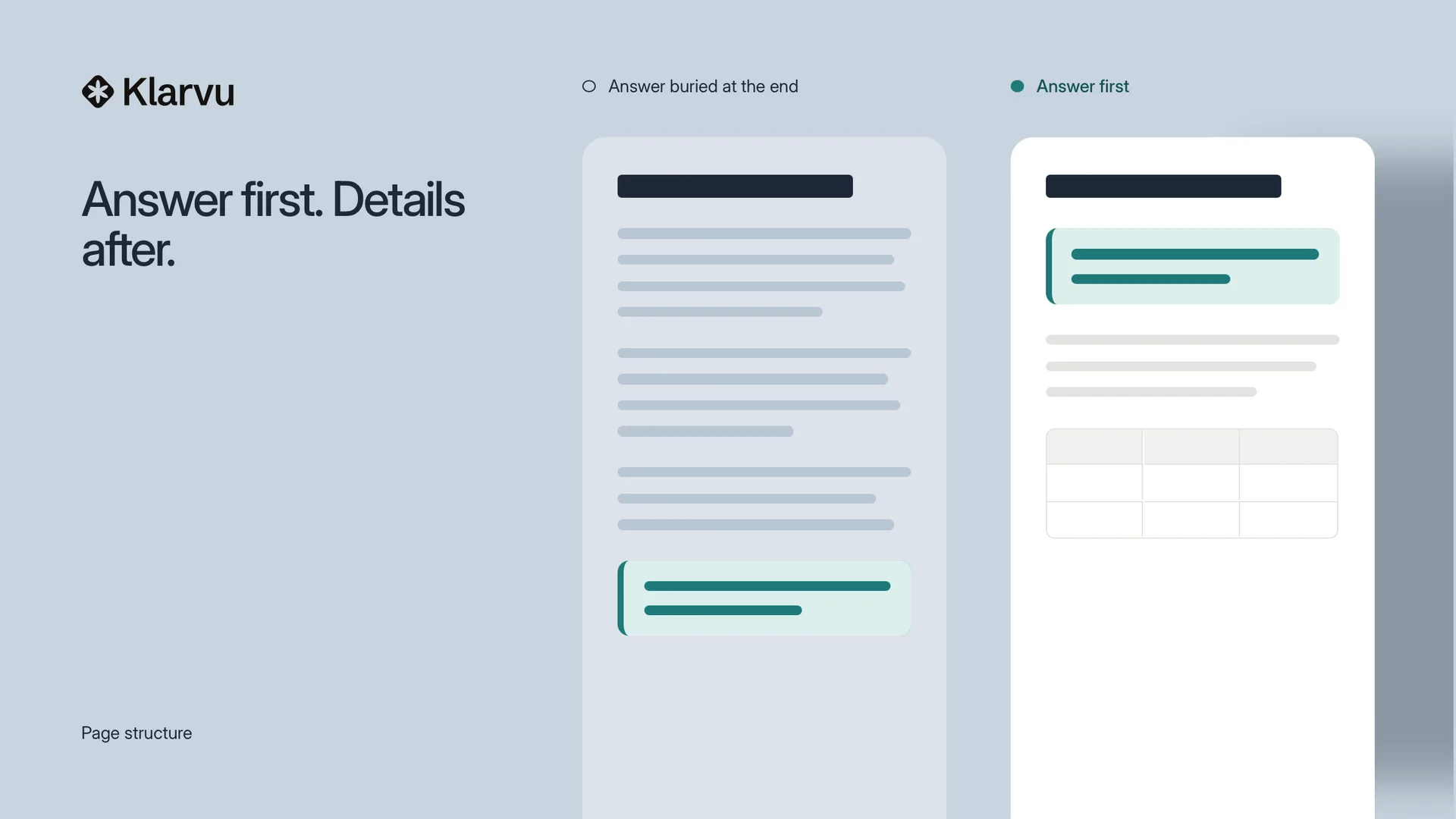
But don't force every page into an artificial question-and-answer structure.
The goal is to provide information that remains understandable when someone encounters a particular section without reading everything around it.
That's a useful editorial standard for both people and retrieval systems.
4. Publish information worth citing
There's a difference between explaining a topic well and contributing something new to it.
Both can be valuable. But original research gives other publishers and search systems information they can't simply obtain from a hundred similar articles.
For example, an AI visibility company could investigate how often Perplexity recommends the same brands as ChatGPT and Claude.
It could collect answers to a consistent set of questions and examine the brands, domains, and recommendations appearing across platforms.
A cybersecurity company might publish original threat analysis. A logistics company could examine changing shipping capacity. A software vendor could publish a carefully designed performance benchmark.
The research doesn't have to be enormous.
What matters is whether readers can understand and evaluate the findings.
Explain the methodology, sample size, dates, selection criteria, and limitations. If the analysis involves AI-generated answers, document which models and settings were used.
There's academic research suggesting that source presentation can influence visibility in generative search.
The 2024 paper GEO: Generative Engine Optimization studied methods for improving source visibility in experimental generative engines.
Its findings are relevant background, but they aren't proof that a particular technique guarantees citations in Perplexity today.
A better reason to publish original research is that it answers a question with evidence readers would otherwise struggle to find.
5. Study the sources Perplexity already cites
This is one of the most useful exercises a business can perform.
Instead of guessing which websites might influence your visibility, examine the sources Perplexity actually uses.
Imagine you're a company selling HR software.
You run 30 relevant questions about employee engagement platforms, performance reviews, and HR software for growing companies.
For every answer, you collect the cited URLs.
You then group the sources into categories:
| Source category | What to investigate |
|---|---|
| Company websites | Which competitors are cited directly, and for what information? |
| Product comparison sites | Are your competitors included while your company is missing? |
| Industry publications | Which topics and companies receive independent coverage? |
| Community discussions | What questions, experiences, and complaints do users discuss? |
| Research and reports | Which original findings are used to support answers? |
This example describes a possible research method, not actual findings from a Klarvu study.
Over multiple questions, you may begin to notice recurring domains.
Perhaps Perplexity frequently cites an industry publication that has never covered your company. Or a software directory contains an outdated description of your product.
Those observations can help you decide where to focus.
Sometimes that means improving your own pages. Sometimes it means submitting accurate information to a relevant directory or making original research available to journalists and analysts.
It doesn't mean trying to place promotional content everywhere.
Independent coverage should be earned, and customer reviews should reflect genuine experiences.
It's equally important to recognize when a competitor is simply a better answer to a particular question.
The purpose of source analysis is to understand your position, not to manufacture an appearance of authority.
6. Keep product facts accurate wherever they appear
Imagine your company recently introduced an integration with a popular CRM platform.
Your website has been updated, but several independent software directories still say you don't offer it.
Someone asks Perplexity:
"Which customer support platforms integrate with this CRM?"
Depending on which sources Perplexity retrieves, your product could be overlooked or described inaccurately.
You can't directly control every external source. But you can make it easier for those sources to get the facts right.
Keep your official product documentation clear and current. Review listings on relevant directories, partner websites, and company profiles.
For software products, pay particular attention to pricing, supported platforms, integrations, availability, and differences between subscription tiers.
There's no need to use identical marketing descriptions everywhere. The underlying product facts should simply be consistent.
Perplexity has documented that its indexing system uses machine learning to prioritize newly discovered and updated pages.
That makes accurate updates meaningful, particularly for time-sensitive information.
But there is no guarantee that changing a page will immediately alter Perplexity's answers.
Measure what happens rather than assuming an update has already been reflected.
7. Track citations, recommendations, and competing sources
Once you've investigated the opportunities and made changes, you need a way to assess your visibility.
Start with a consistent set of questions relevant to your customers.
Include different stages of the buying process: general research, product comparisons, specific capabilities, and recommendations.
Then distinguish between four measurements.
| Metric | What it measures |
|---|---|
| Brand mention rate | Percentage of tested answers mentioning your brand. |
| Website citation rate | Percentage of answers citing at least one page from your website. |
| Recommendation rate | Percentage of relevant recommendation answers suggesting your brand. |
| Citation share | Your share of all counted source-domain appearances across the tested answers. |
Consider a hypothetical example.
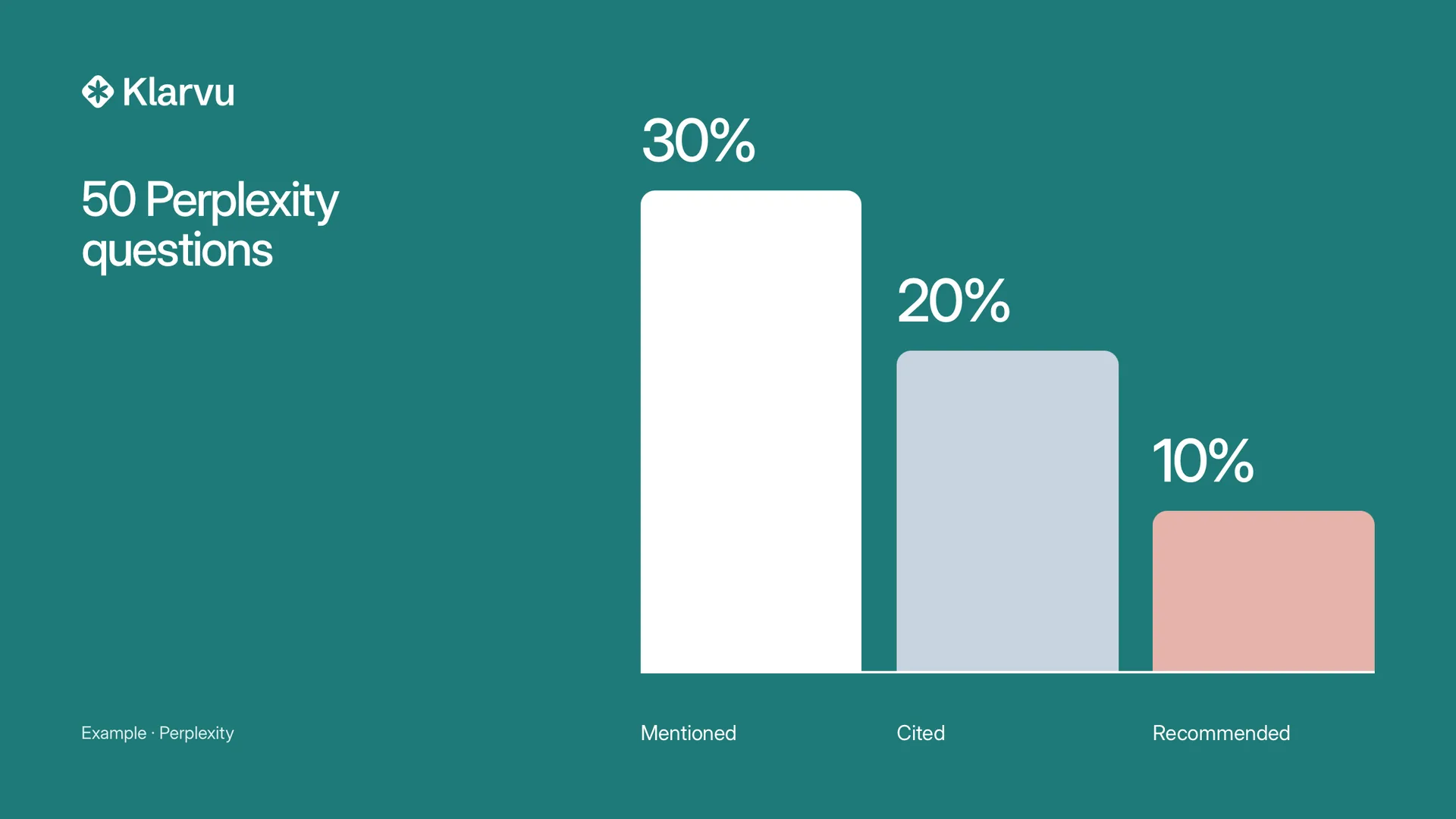
You test 50 questions in Perplexity.
Your brand appears in 15 answers, your website is cited in 10, and your company is recommended in 5.
That produces a mention rate of 30% and a website citation rate of 20%.
If all 50 questions are genuine recommendation opportunities, the recommendation rate is 10%. Otherwise, calculate it using only the eligible recommendation questions.
But there's another question worth asking.
Who received the remaining citations?
Imagine your test produced 250 cited-domain appearances in total, counting each domain at most once per answer.
If your domain appeared in 10 of those instances, its citation share would be 4%.
That tells you something different from the website citation rate.
The citation rate describes how many answers included your website. Citation share describes your portion of the sources used across the tested answers, under a clearly defined counting method.
You can also examine source overlap: how often your website appears alongside competitors or independent publications in the same answer.
And don't confuse citations with website traffic.
A citation is evidence of source visibility. Whether users click through and eventually become customers is a separate measurement.
At Klarvu, we help companies track brand mentions, citations, recommendations, and competing brands across AI platforms, including Perplexity.
That makes it easier to compare relevant questions over time and identify where a company is gaining or missing visibility.
What Perplexity's citations can tell you about competitors
Source analysis becomes especially interesting when you combine it with brand recommendations.
Imagine three hypothetical outcomes from the same product category.
Situation A: Your website is cited, but competitors are recommended.
Your content may be useful as a source of information without your product being considered the best match. Review what questions the recommendations are answering and whether your product fits those needs.
Situation B: Your competitors' websites are cited directly, but yours is absent.
Inspect the cited pages. Do they provide specifications, pricing, integrations, or evidence that your website lacks?
Situation C: Independent publishers dominate the citations.
Your industry's comparison sites, publications, or community discussions may be especially important in the answers you tested. Investigate the accuracy and completeness of your company's presence in those sources.
None of these patterns proves exactly why Perplexity selected particular citations.
But each gives you a better question to investigate than simply asking how to rank higher in AI.
How Perplexity SEO differs from Google SEO
Traditional SEO and Perplexity optimization share many practical foundations.
Both benefit from accessible websites, relevant information, useful content, and credible references.
The differences become clearer when you examine what you're measuring.
| Traditional Google SEO | Perplexity visibility |
|---|---|
| Track rankings and search impressions | Track inclusion in cited sources and generated answers |
| Analyze search results and competing pages | Analyze cited domains and recommended companies |
| Measure organic clicks and conversions | Measure citations and recommendations, alongside referral traffic and outcomes |
| Improve pages for search intent | Test specific questions and the information needed to answer them |
These aren't mutually exclusive approaches.
A well-maintained product page can support both traditional organic search and AI-assisted research.
However, ranking well on Google doesn't guarantee that Perplexity will cite your website.
Perplexity operates its own search infrastructure and makes source selections within its retrieval and answer-generation processes.
There's also a difference between Perplexity's search experiences.
According to its Pro Search documentation, Pro Search can perform more extensive research and use a broader collection of sources than standard search.
When measuring visibility, record the search mode, model selection where applicable, date, language, and other relevant settings.
Otherwise, you may end up comparing different experiences without realizing it.
For the other platforms, see our guides to getting cited in ChatGPT, Claude, and Gemini.
A practical 30-day plan
You don't need to rebuild your entire website to start.
A smaller investigation will often reveal more useful opportunities.
| Week | What to do | What you'll learn |
|---|---|---|
| Week 1 | Check Perplexity crawler access. Collect and test a fixed set of customer questions. | Your technical accessibility and initial citation baseline. |
| Week 2 | Review the pages most relevant to those questions. Improve missing facts, explanations, and documentation. | Which content gaps you can address directly. |
| Week 3 | Group Perplexity's cited URLs by domain and source type. Investigate competitors and third-party references. | Where your business is missing or inaccurately represented. |
| Week 4 | Repeat the tests under comparable conditions. Review citations, mentions, recommendations, and source overlap. | What changed and which questions deserve further investigation. |
Thirty days is enough to establish a useful starting point, but not enough to guarantee measurable improvement.
Perplexity's sources and answers can vary. Changes in visibility may have several explanations, and a single before-and-after comparison won't prove causation.
What matters is developing a consistent way to investigate the results.
Frequently asked questions
How do I get my website cited by Perplexity?
Allow PerplexityBot to access relevant public content, make sure your pages can be retrieved, and provide accurate information that addresses the questions your audience asks. Investigate which sources Perplexity currently cites, and track whether your website appears in relevant answers. There is no guaranteed method for earning citations.
Does Perplexity have its own search index?
Yes. In a September 2025 technical article, Perplexity said its search index tracked more than 200 billion unique URLs. The company described its Search API architecture as combining keyword and semantic retrieval with multiple ranking stages. That doesn't mean every citation in every Perplexity product can be explained solely by this published architecture.
What's the difference between PerplexityBot and Perplexity-User?
PerplexityBot is a search crawler designed to help Perplexity discover and link websites. Perplexity-User retrieves information in response to user actions. According to Perplexity, it generally ignores robots.txt restrictions because those requests are user-initiated. Both agents are documented separately from foundation-model training crawlers.
Does Perplexity prefer recently updated content?
Freshness matters when a question depends on current information. Perplexity has described using machine learning to help schedule indexing and refreshes. But it hasn't published a rule saying that recently dated pages automatically receive better citation placement. Update the information, not just the date.
Does Perplexity cite Reddit and other community websites?
It can. Community discussions may contain relevant first-hand experiences, opinions, and practical information. Whether those discussions are appropriate sources depends on the question. Personal experiences shouldn't automatically be treated as verified facts.
Can I pay to get cited in Perplexity?
There is no established way to buy a guaranteed organic source citation. Advertising arrangements, where available, should be distinguished from citations selected as part of an answer's supporting sources. Be skeptical of anyone promising guaranteed organic citations through undisclosed ranking methods.
How long does it take to improve Perplexity visibility?
There is no reliable universal timeline. Retrieval depends on accessibility, relevance, indexing, competing sources, and the user's question. Track changes over multiple tests rather than expecting one update to produce an immediate result.
Start with the sources, not another SEO checklist
Choose ten questions your customers might ask Perplexity.
Look at the answers, but spend just as much time examining the source links.
Which websites appear repeatedly? Are your competitors cited directly? Do independent publishers provide most of the supporting information? And where is your own website missing?
You might discover that the next opportunity isn't another blog article.
It could be clearer product documentation, an original industry study, or correcting an outdated description on a website Perplexity already cites.
Those are more useful starting points than guessing which hidden AI ranking factor to optimize.