How to Get Your Brand Cited in Claude (2026 Guide)
Short answer
To get your website cited in Claude, start by making sure Anthropic's search crawlers can access your content. Then focus on publishing useful, well-supported information that answers the questions your potential customers ask. Build credible references beyond your own website, keep important business details up to date, and monitor when Claude actually uses your content as a source.
There's one important detail to understand first: Claude doesn't search the web for every question. And when it does, a citation and a brand recommendation are two different outcomes.
A company can appear in Claude's recommendations without receiving a single link to its website. Another company might have its research cited repeatedly without ever being suggested as a product or service.
Both are visible, but in very different ways.
If you're trying to improve your presence in Claude, it helps to understand how these situations happen. When does Claude search the web? Which websites does it reference? And what can a business realistically do to become one of those sources?
Anthropic has documented parts of this process, and independent research is beginning to reveal some interesting patterns. There's still plenty we don't know.
This guide covers what we do know, where the uncertainties are, and seven practical steps worth taking.
What does it mean to get cited in Claude?
When Claude uses web search, it can include links to the sources supporting its answer. These are citations.
Imagine someone asks Claude:
"What are the best AI visibility monitoring tools for a small marketing team?"
Claude might recommend several platforms, describe their capabilities, and cite websites that support its comparisons.
Your business could appear in three different ways:
| Type of visibility | What it means |
|---|---|
| Brand mention | Claude names your company or product in its answer. |
| Website citation | Claude links to a page on your website as a supporting source. |
| Brand recommendation | Claude suggests your business as a relevant option for the user's needs. |
These distinctions matter more than they might initially seem.
Suppose your company publishes a detailed comparison of AI visibility platforms. Claude could cite that article while recommending three competing products. Your content contributed to the answer, but your business wasn't recommended.
The reverse is possible too. Claude might recommend your company based on information available to the model without providing a direct link to your website.
This is why citation tracking alone gives an incomplete picture of AI visibility.
A citation tells you something about which sources Claude uses. A recommendation tells you something about which businesses it considers relevant to the question.
Ideally, you want to understand both.
For a closer look at the recommendation side, read our guide on how to get AI to recommend your business.
How does Claude decide which websites to cite?
Before looking at individual optimization strategies, it's worth understanding something specific to Claude.
Claude's first decision is often whether it needs to search the web at all.
According to Anthropic's web search documentation, Claude can respond using its existing knowledge or retrieve current information through web search.
The distinction is fairly intuitive.
Ask Claude to explain a well-established concept, and it may answer directly. Ask about recently updated software pricing, a new product launch, or the best tools available in 2026, and fresh information becomes more relevant.
When Claude searches, it can retrieve sources and include citations in its response.
When it answers without searching, there generally won't be live web citations to compete for.
That has an important implication for businesses.
You could publish an excellent article, make it accessible to every relevant crawler, and still receive no citation for a particular question simply because Claude answered without retrieving the web.
Improving your website doesn't immediately change what's already represented in a model's knowledge.
What independent research tells us about Claude's search behavior
In July 2026, researchers Josh Blyskal and Jasman Singh published an analysis of how Claude and ChatGPT use search.
Their research, associated with the AI visibility company Profound, found that Claude invoked web search for 36.6% of the prompts in their tested sample, even when web search was enabled.
For the remaining prompts, Claude answered without searching.
The researchers also found a striking relationship between Claude's citations and Brave Search.
Across approximately 35,000 URLs associated with 400 queries, 79.2% of Claude's cited URLs also appeared in Brave Search's top 10 results.
That suggests Brave can be a useful place to investigate potential source visibility.
But there's an important distinction between correlation and causation.
The study doesn't prove that Brave directly determined every source Claude selected, or that ranking in Brave guarantees a Claude citation. The complete retrieval process isn't publicly documented, and the findings reflect a particular collection of prompts and testing conditions.
It's also worth remembering that the study's 36.6% search rate isn't a universal benchmark. A test focused entirely on current product prices could produce very different behavior from one focused on general explanations.
Still, the findings point toward a useful approach: investigate whether Claude searches for your target questions before trying to explain why your website isn't cited.
You can read the full 2026 research analysis here.
How to get cited in Claude: 7 practical strategies
There isn't an official Claude citation ranking checklist.
Anthropic hasn't published a complete formula explaining how individual webpages are selected, evaluated, and cited across its products.
That means any article promising guaranteed Claude rankings should be treated with some skepticism.
What businesses can do is improve the information available to Claude, investigate the sources it uses, and measure whether those changes are associated with better visibility.
Here are seven places to start.
1. Find out what Claude actually says about your business
Before changing your website, investigate the answers you're trying to influence.
Start with questions your potential customers might realistically ask Claude.
For an AI visibility software company, these could include:
- "How can I measure whether ChatGPT recommends my business?"
- "Which AI visibility tools are suitable for a small marketing team?"
- "What are the alternatives to Profound for companies with smaller budgets?"
- "Which tools can monitor brand mentions across Claude, Gemini, and Perplexity?"
Notice how different those questions are.
The first asks for an explanation. The second asks for recommendations. The third introduces competitors and price sensitivity. The fourth focuses on specific capabilities.
A business might perform well for one and be completely absent from another.
Run the questions in Claude and examine the responses carefully.
Did Claude search the web? Which websites were cited? Were competitors mentioned? Did your business appear, and was the description accurate?
Pay particular attention to the difference between questions that trigger web search and those that don't.
A missing citation in an answer generated without search tells you something different from a missing citation in an answer that references five competing websites.
For a more reliable picture, repeat your tests and document the model, date, location or language settings, and search conditions. AI responses can vary between runs.
The objective at this stage is simple: understand what's happening before deciding what to fix.
2. Make sure Anthropic's crawlers can access your website
This is one of the most concrete technical checks you can make.
Anthropic operates three web crawlers with different purposes.
| Crawler | What it does |
|---|---|
| Claude-SearchBot | Crawls web content to improve Claude's search results. |
| Claude-User | Retrieves webpages in response to certain user requests. |
| ClaudeBot | Collects publicly available content that may contribute to model training. |
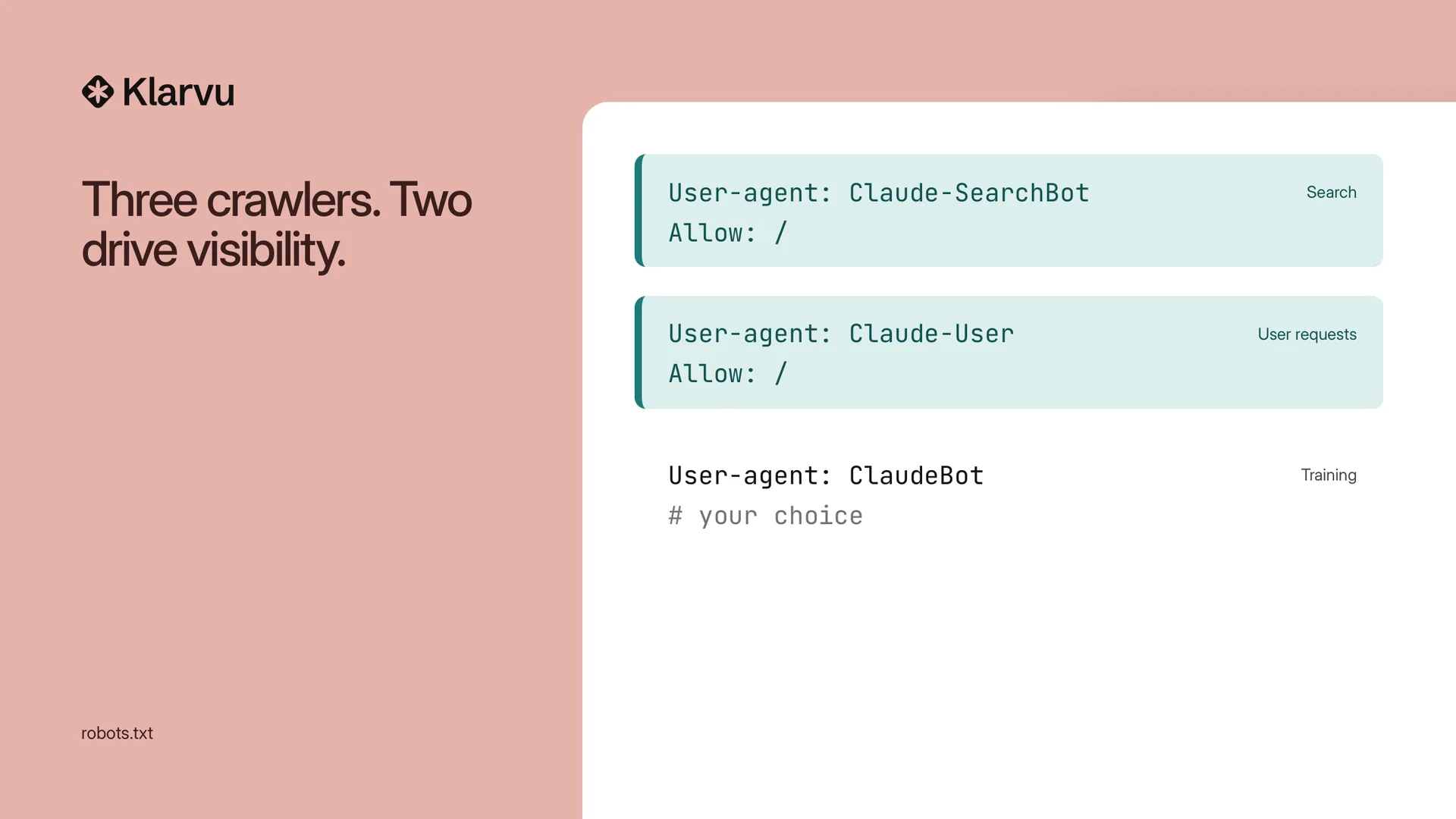
For businesses interested in being discovered through Claude's web search, the first two are particularly relevant.
According to Anthropic's official crawler documentation, blocking Claude-SearchBot prevents Anthropic's system from indexing your content for search optimization. Blocking Claude-User can prevent certain user-requested retrievals.
ClaudeBot has a different purpose related to potential model training.
You can allow search-related crawling without automatically allowing training-related crawling.
Website owners can manage these permissions separately through their robots.txt file.
For example, to explicitly allow Anthropic's search and user-request crawlers:
User-agent: Claude-SearchBot
Allow: /

User-agent: Claude-User
Allow: /
This is only an example. Your complete robots.txt configuration may contain other rules, and the appropriate policy depends on your website's requirements.
You can normally find the file at yourdomain.com/robots.txt.
But checking robots.txt is only part of the process.
Your hosting provider, CDN, or firewall might block crawler requests even when robots.txt permits them. If you have access to server logs, check whether legitimate requests are receiving errors such as 403 Forbidden or 429 Too Many Requests.
It's also worth inspecting the HTML your server returns.
If important product information only appears after complex JavaScript execution, automated retrieval systems may have difficulty accessing it. Server-side rendering or static HTML can help make that information more readily available.
A practical check should cover three things:
- Are the relevant Anthropic crawlers permitted?
- Can they retrieve your important pages without being blocked?
- Does the retrieved content actually contain the information you want them to find?
Technical accessibility won't guarantee citations, but a blocked or unreadable page is an avoidable obstacle.
For more detail, see our guide to AI crawlers and robots.txt.
3. Give Claude something specific and useful to reference
A surprisingly common problem with company websites is how little concrete information they contain.
A software company might describe itself as an intelligent, all-in-one platform that helps businesses work smarter.
That sounds polished, but it leaves some fairly basic questions unanswered.
What does the software actually do? Which systems does it support? Who is it designed for? What are its limitations?
Consider a company offering AI visibility monitoring.
If a potential customer asks Claude which platforms can track brand recommendations across multiple AI assistants, a useful product page would explain:
- Which AI platforms the software monitors.
- Whether it tracks mentions, citations, recommendations, or all three.
- How the data is collected and updated.
- Whether companies can compare their visibility against competitors.
- Which limitations or coverage differences buyers should know about.
These details help a human buyer evaluate the product. They also provide specific facts that Claude can potentially use when constructing an answer.
The same principle applies to educational content.
If your article answers a particular question, provide the actual answer before introducing ten loosely related topics.
If you're comparing products, explain the criteria behind the comparison. If you're publishing statistics, identify their sources. If you're describing a technical feature, document how it works.
You don't need to turn every page into a collection of short answers or rigidly structured tables.
Anthropic hasn't published a preferred paragraph length, heading format, or content template for citations.
The more useful question is whether someone reading your page can find the information they came for, understand it, and check whether it's correct.
That's a reasonable editorial standard regardless of which AI assistant eventually retrieves the content.
4. Publish information that doesn't already exist everywhere else
There's no shortage of articles explaining how to improve AI visibility.
Many contain essentially the same recommendations, rewritten with different headings.
From a reader's perspective, the problem is obvious: once you've read one, you've often read most of them.
A more interesting opportunity is to publish something original.
For example, a company offering AI visibility software could investigate whether Claude recommends the same businesses as ChatGPT and Perplexity.
Instead of writing another general comparison, it could collect answers to a standardized set of questions and examine:
- How frequently the same brands appear across platforms.
- Which websites each platform cites.
- Whether product descriptions are accurate.
- How recommendations vary between informational and purchase-oriented questions.
The resulting article would contain information that readers couldn't simply find by visiting the companies' product pages.
Other industries have similar opportunities.
A cybersecurity company might publish findings from its own threat research. A logistics company might analyze changes in shipping capacity. A software vendor might publish a transparent benchmark comparing the performance of different approaches.
Original information gives other researchers, publishers, and potentially AI systems something distinctive to reference.
There is academic interest in this area too. The research paper GEO: Generative Engine Optimization, presented at KDD 2024, examined how changes to source content could affect visibility in experimental generative search environments.
It provides useful evidence that the presentation and substance of information can matter. However, its findings shouldn't be interpreted as a guaranteed method for securing citations in today's Claude.
And original research only carries weight when readers can assess it.
If you publish a study, explain how many observations you collected, when the research took place, how the sample was selected, and what the limitations are.
A modest investigation with transparent methodology can be more valuable than an impressive headline built on data nobody can verify.
5. Investigate the websites Claude already trusts enough to cite
Your own website is only one part of your company's online presence.
When Claude answers a question about a product category, it may cite company websites, independent comparisons, industry publications, directories, or other relevant sources.
Which ones appear depends on the question and the retrieval process.
This creates an opportunity that many businesses overlook.
Instead of guessing where you should build external visibility, examine the websites Claude actually references.
Imagine you're selling project management software.
You test several questions about software for small consultancies and notice that Claude repeatedly cites a handful of independent comparison sites.
Your competitors appear in those comparisons. Your product doesn't.
That gives you something specific to investigate.
Perhaps your company is missing from an important directory. Perhaps an independent publication hasn't reviewed your product. Or perhaps the available descriptions are outdated or incomplete.
You can then decide whether there's a legitimate opportunity to provide updated information, pursue editorial coverage, or contribute original expertise.
The objective shouldn't be to accumulate mentions across hundreds of unrelated websites.
A relevant and accurate reference in a publication your customers genuinely use is more meaningful than a promotional listing created solely to generate another backlink.
Be cautious about fabricated reviews, paid endorsements presented as independent opinions, or attempts to manufacture authority.
Beyond the ethical issues, those approaches can leave potential customers with a distorted understanding of your company.
There's another reason to investigate external sources: they can reveal how competitors are positioned.
If Claude repeatedly describes another provider as suitable for enterprise teams, for example, look at the evidence supporting that description.
Does your company offer comparable functionality? Is that information documented? Is the competitor genuinely a better fit?
Not every visibility gap needs to be solved with new content.
Sometimes the answer is that your product isn't the most relevant option for that particular question.
Knowing the difference is valuable.
6. Keep your product information accurate and consistent
Consider what happens when a company changes its pricing, introduces a new feature, or expands into a different market.
Its website gets updated, but older information might remain on software directories, partner websites, and comparison articles.
Now imagine someone asking Claude to compare that company with three alternatives.
If Claude retrieves older sources, the resulting description may not reflect the company's current offering.
This is especially relevant when buyers ask about features, pricing, availability, integrations, or other information that changes over time.
Review the places where your business is described and make sure the important details are current.
Your own website should be the clearest source of information about your product.
For a software company, that means maintaining accurate feature documentation, integration information, pricing pages, and product descriptions. If capabilities differ by subscription, make those differences clear.
External profiles should reflect the same underlying facts.
This doesn't mean every platform needs an identical company description. An industry directory and a LinkedIn page serve different purposes.
But they shouldn't contradict each other about what your product does.
Publication dates also deserve attention.
A genuinely updated article can help readers understand whether its information is current. Simply changing the date on an old article without revisiting its claims doesn't achieve the same thing.
One limitation is worth repeating: updating information online doesn't instantly update Claude's existing model knowledge.
What it does is improve the information available for future retrieval and for the people and publishers who rely on those sources.
7. Measure what Claude mentions, cites, and recommends
Once you've improved your website and investigated relevant sources, you need a way to evaluate the results.
This is where Claude's search behavior becomes particularly important.
A company might receive fewer citations than expected because Claude rarely searches for its target prompts.
Another might appear in many search results but still receive few direct citations.
Those are different problems.
A useful monitoring process should therefore separate several measurements.
| Metric | What it tells you |
|---|---|
| Brand mention rate | How often Claude names your brand. |
| Overall website citation rate | How often Claude cites your website across all tested answers. |
| Search-conditioned citation rate | How often your website is cited among answers that used web search. |
| Recommendation rate | How often Claude recommends your brand in relevant recommendation answers. |
| Search usage rate | How often Claude uses web search for the tested prompts. |
| Competitor visibility | Which competing companies appear and in what contexts. |
The denominators matter.
Consider a hypothetical test with 40 Claude answers:
- Claude uses web search in 20 answers.
- Your brand is mentioned in 12 answers.
- Your website is cited in 4 answers.
That produces three different results.
- Brand mention rate: 30% — 12 out of 40 answers mention your company.
- Overall website citation rate: 10% — 4 out of 40 answers cite your website.
- Search-conditioned citation rate: 20% — 4 out of the 20 answers that used search cite your website.
The search usage rate is 50%.
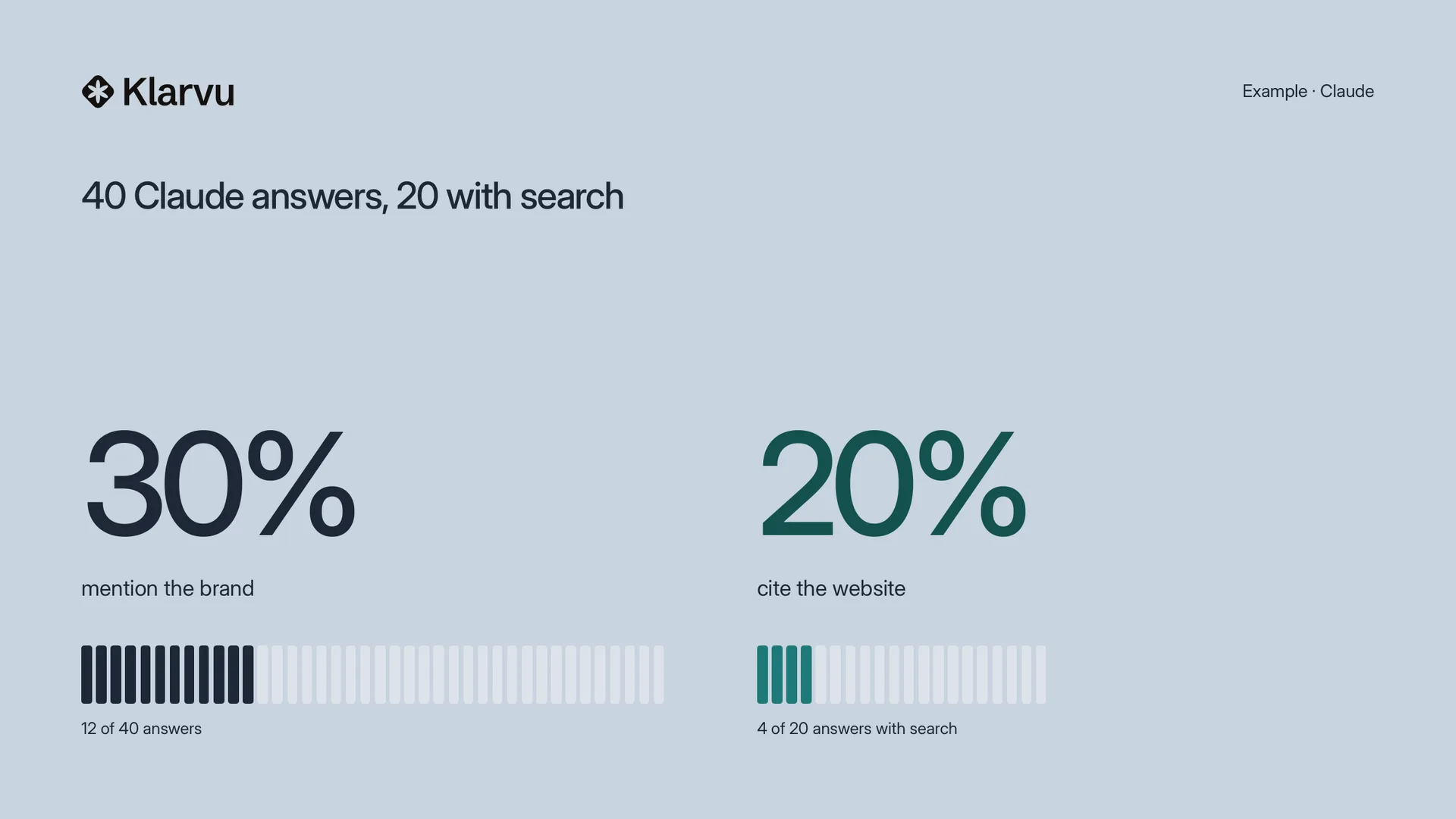
All four numbers describe the same set of answers. But they reveal different things.
If you're comparing citation performance across AI platforms, you need consistent definitions. A citation rate calculated across all answers shouldn't be compared directly with one calculated only across search-based answers.
It's also helpful to keep the original responses.
A numerical summary might show that your brand appeared in 30% of answers, but it won't necessarily tell you whether Claude described your company accurately or recommended it for the right reasons.
For meaningful comparisons over time, keep the prompt set and testing conditions as consistent as possible. Record changes in models and search availability, and use repeated observations where practical.
At Klarvu, we help businesses monitor how AI platforms mention, cite, and recommend their brands, including which competitors and source websites appear in the answers.
That makes it easier to move from a single interesting response to a clearer picture of visibility over time.
You can explore how Klarvu works here.
Why Claude might mention your brand without citing your website
This is one of the more interesting patterns to look for when monitoring Claude.
A mention doesn't necessarily mean Claude recently visited your website.
Likewise, a citation doesn't necessarily mean Claude considers your company a recommended choice.
Here's how to interpret some common situations.
| What you observe | What it might mean |
|---|---|
| Your brand appears without a citation | Claude may be using existing knowledge or information from sources that aren't directly linked in the answer. |
| Your website is cited, but your company isn't recommended | Claude may find your content useful without considering your product the best match. |
| Claude cites competitors but not your website | Other sources may better address the question, or your content may be missing or difficult to retrieve. |
| Claude describes your product incorrectly | Its information may be incomplete, outdated, or drawn from inaccurate sources. |
| Claude provides no web citations | It may have answered without web search. |
These aren't definitive diagnoses.
For example, a missing citation doesn't prove that your website has a crawler problem. And a competitor's recommendation doesn't prove that Claude has a permanent preference for that business.
The useful approach is to examine the answer, its source links, and the question that produced it.
Over several tests, patterns may begin to emerge.
You might discover that your company is frequently recommended for one audience but missing from another. Or that your educational content is cited regularly while your product pages are rarely referenced.
Those findings can help you decide which improvements deserve attention.
Is Claude SEO different from ChatGPT and Perplexity SEO?
There are similarities across AI search platforms, but the differences are worth understanding.
Claude, ChatGPT, and Perplexity can all provide answers supported by web sources. They don't necessarily retrieve the same information, select the same sources, or present citations in the same way.
Claude can answer from model knowledge or use web search. Anthropic also provides distinct crawlers for search, user-requested retrieval, and potential model training.
ChatGPT has its own search functionality and crawler infrastructure, including OAI-SearchBot.
Perplexity is built around web-connected research and prominently displays supporting sources.
Independent research has found meaningful differences in the sources these systems cite. The 2026 analysis discussed earlier reported limited overlap between Claude and ChatGPT citation domains in its tested queries.
That doesn't mean one platform is inherently better for brands.
It means a company's visibility in one assistant isn't a reliable substitute for measuring its visibility in another.
You may find that the same company is recommended in Claude, cited in Perplexity, and absent from a comparable ChatGPT answer.
To understand why, examine each platform separately before combining the results into an overall AI visibility picture.
For more platform-specific guidance, see:
A practical 30-day plan for improving Claude visibility
You don't need to redesign your entire website to begin investigating Claude visibility.
A more useful starting point is a small, structured process that tells you where the opportunities are.
| Week | What to do | What you should have afterward |
|---|---|---|
| Week 1 | Check Anthropic crawler access and test a consistent set of relevant prompts. | A technical accessibility check and a baseline of Claude answers and citations. |
| Week 2 | Review your most relevant website pages. Improve missing product facts, explanations, and supporting evidence. | Better documentation and a record of the changes made. |
| Week 3 | Investigate external websites Claude frequently cites. Identify missing or inaccurate references and potential original content opportunities. | A prioritized list of content and external visibility improvements. |
| Week 4 | Repeat your prompt tests under comparable conditions. Review mentions, citations, recommendations, and source changes. | An initial comparison and a clearer idea of what to investigate next. |
Don't expect every improvement to appear in Claude within 30 days.
Search behavior changes, sources are updated at different times, and responses can vary between models and repeated prompts.
The point of the exercise is to establish a baseline, make deliberate improvements, and begin collecting evidence.
When something changes, investigate whether it coincided with your work. Avoid assuming that every positive movement was caused by a particular edit.
That's a better foundation for long-term AI visibility than making dozens of changes without knowing what problem you're solving.
Frequently asked questions
How do I get my website cited by Claude AI?
Start by confirming that Claude-SearchBot and Claude-User can access your public website. Publish content that provides clear, accurate answers to relevant questions, support important claims with credible evidence, and maintain useful references beyond your own website. Then test whether Claude actually retrieves and cites your pages for relevant questions. There is no guaranteed method for securing a citation.
Does Claude always search the web before answering?
No. Claude can answer questions using its existing knowledge. When web search is available, it may retrieve current information for questions involving recent developments, products, pricing, or other changing facts. In newer Claude experiences, web search can happen automatically when Claude determines that it's useful. Some other configurations allow users or workspace administrators to control search availability. This is why it's important to record whether a particular answer used web search rather than assuming that every response was based on freshly retrieved sources.
Does Claude use Brave Search?
Independent research has found substantial overlap between Claude's citations and Brave Search results. A July 2026 analysis associated with Profound found that 79.2% of Claude's cited URLs in the examined dataset also appeared in Brave's top 10 results. That makes Brave potentially useful when investigating why certain pages appear in Claude's answers. However, Anthropic hasn't publicly established Brave as the exclusive source for every Claude search product or configuration. The observed overlap doesn't prove a universal ranking mechanism.
Do I need to allow ClaudeBot to get cited?
Not necessarily. Anthropic distinguishes between ClaudeBot, which collects content that may contribute to model training, and the search-related Claude-SearchBot and Claude-User crawlers. Website owners can manage these permissions independently. If your priority is making current website content accessible for search-related retrieval, focus on understanding and configuring the relevant search and user-request permissions.
Does schema markup help with Claude citations?
Structured data can help represent information about a webpage, such as its author, organization, or publication date, in a standardized format. It can be useful for conventional search and for maintaining clear information about your content. However, Anthropic hasn't publicly confirmed that implementing a particular schema type directly increases Claude citation rankings. Treat schema markup as part of good website information architecture, not as a guaranteed Claude optimization technique.
How long does it take to appear in Claude citations?
There isn't a reliable universal timeframe. It depends on whether Claude searches for the relevant question, whether your pages can be retrieved, and which sources it selects. Even after you update your website, there may be a delay before changes are reflected in retrieved information or AI-generated answers. Monitor results over time rather than expecting immediate movement.
Can I pay to appear in Claude's citations?
There is no generally available method for purchasing a guaranteed editorial citation in Claude's web-search answers. Be cautious of agencies or services claiming they can guarantee citations through secret ranking factors or special access. A more useful investment is making your business's information accurate, accessible, relevant, and supported by credible evidence.
Where should you start?
Pick five questions that your customers might realistically ask Claude.
Run them and look at the answers.
Did Claude search the web? Which websites appeared? Were your competitors mentioned? Was your business described accurately?
Those observations will usually tell you more about your starting point than another generic SEO checklist.
If Claude can't retrieve your website, investigate the technical issue. If competitors appear repeatedly in independent sources, examine those sources. If Claude knows your business but describes it incorrectly, look at the information available online.
And if your website is already being cited, ask whether those citations are contributing to the outcomes that actually matter to your business.
You may discover that the next improvement isn't another article. It could be clearer product documentation, better external references, or simply a more accurate way of measuring the answers you're already appearing in.
That's a useful place to begin.
Sources and further reading
The technical explanations and research discussed in this article draw on the following sources: