How to Get Your Brand Cited in Gemini (2026 Guide)
Short answer
To improve your chances of getting cited in Google Gemini, start by making your website discoverable through Google Search, publishing accurate information that answers your customers' questions, and building credible references beyond your own website. Check your indexing and AI content controls, and measure when Gemini mentions, cites, or recommends your business.
But there's an important distinction: Google Gemini, AI Overviews, and AI Mode aren't the same product. Being visible in one doesn't guarantee visibility in the others.
Your website ranks on Google. Your product pages are up to date. Yet when someone asks Gemini to recommend a company like yours, the answer names three competitors instead.
Where should you start looking?
The complication is that Google's AI products don't all use or present information in the same way.
Google has published detailed guidance on how websites can appear in its AI-powered Search experiences, including AI Overviews and AI Mode. It has also introduced new reporting tools and controls that give website owners more insight into how their content appears.
What Google hasn't published is a formula for getting your brand cited or recommended in every Gemini answer.
That leaves us with a more useful approach than guessing at hidden ranking factors: understand the differences between Google's AI experiences, investigate the information they actually show, and improve what you can verify.
Gemini, AI Overviews, and AI Mode: why the differences matter
Before optimizing anything, it helps to understand which Google product you're measuring.
Three experiences are particularly relevant to AI visibility.
| Google product | What it does | What to investigate |
|---|---|---|
| Gemini app | Google's standalone conversational AI assistant, available through its website and mobile apps. | Which brands Gemini mentions, recommends, and links to when answering relevant questions. |
| AI Overviews | AI-generated summaries that appear within certain Google Search results. | Whether your pages appear as supporting links and receive impressions. |
| AI Mode | A conversational search experience within Google Search, designed for more complex questions and follow-up research. | Which sources and businesses appear across detailed research questions. |
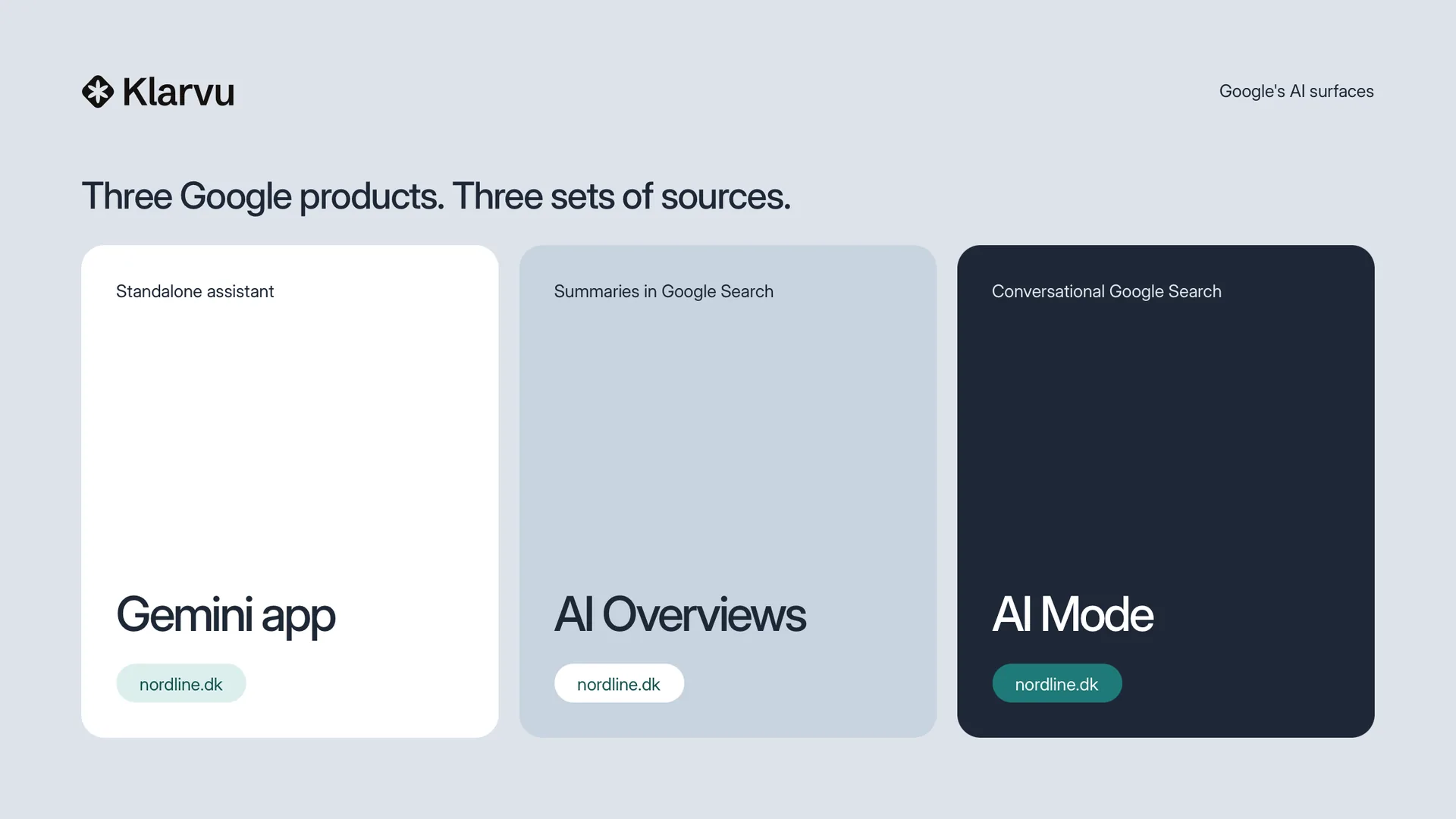
All three can draw on Google's search infrastructure, but their responses and links aren't necessarily identical.
A website might appear in an AI Overview without being cited by the Gemini app. A business could be recommended in AI Mode without its own website appearing as a direct source.
The distinction matters because these are different outcomes in different products.
How Google Search finds information for AI-generated answers
Google has documented an interesting technique used by AI Overviews and AI Mode called query fan-out.
Rather than treating every complicated question as a single search, the system can issue multiple related searches across different subtopics and information sources.
Imagine someone asking:
"What's the best accounting software for a small Danish company with international customers?"
Answering that question could involve several related information needs: pricing, multicurrency support, local accounting requirements, integrations, and suitability for small businesses.
Google's AI Search systems can investigate related aspects of a question and use supporting webpages to develop an answer.
That helps explain why a page about one specific capability might appear in a response to a broader product-comparison question.
However, there's an important limitation.
Google documents query fan-out for AI Overviews and AI Mode. That doesn't mean the company has disclosed an identical retrieval process for every answer in the standalone Gemini app.
The Gemini app can use Google Search and other available sources, but not every answer involves the same retrieval behavior.
For a business trying to understand its visibility, that difference is worth keeping in mind.
What counts as a citation in Gemini?
Imagine someone asks Gemini:
"Which AI visibility platforms can track brand recommendations across ChatGPT, Claude, and Gemini?"
Your company could appear in the response in three different ways.
| Visibility type | What it means |
|---|---|
| Brand mention | Gemini names your company or product. |
| Website citation | Gemini presents a page from your website as a supporting source. |
| Brand recommendation | Gemini suggests your company as a relevant option for the user's needs. |
These outcomes can overlap, but they don't have to.
Gemini might link to an educational article on your website while recommending a competitor's software.
Or it might recommend your product without providing a direct link to your website.
That's why monitoring citations alone doesn't give you a complete picture of your AI visibility. Our guide on how to get AI to recommend your business covers the recommendation side in more depth.
Not every link in Gemini means the same thing
Google's documentation makes another distinction worth understanding.
Gemini can display sources and related links alongside an answer. Not every response includes them.
Depending on the available features, Gemini may also offer ways to check information against Google Search.
A link discovered through a subsequent fact-checking process isn't necessarily a source used to generate the original answer.
This matters if you're collecting AI citations.
If you count every related link or verification result as a direct citation, you may end up measuring something different from what you intended.
A reliable measurement process should document which links are presented as answer sources, which are simply related resources, and which appear through a separate verification process.
The interface can change over time, so the counting rules should be explicit.
7 practical ways to improve your Gemini visibility
There's no official Gemini citation-ranking checklist.
Google's documentation tells us quite a lot about eligibility and optimization for AI features in Search, but it doesn't reveal the complete source-selection process behind Gemini answers.
The following steps focus on improvements you can make and questions you can investigate.
1. Check whether Google can discover and use your website
Start with your technical setup.
For websites aiming to appear in AI Overviews and AI Mode, Google states that pages must be indexed and eligible to appear in Search with a snippet.
That makes ordinary Search accessibility a useful starting point.
Check whether:
- Googlebot can crawl your important public pages.
- Those pages are indexed.
- Your
robots.txtfile blocks relevant content. - Important pages contain unintended
noindexdirectives. - Your canonical URLs and internal links are configured correctly.
- Your main content is available in a form Google can process.
Use Google Search Console to inspect individual URLs and identify indexing problems.
But indexing is only part of the picture.
Google now provides additional controls for how website content is used in different AI experiences.
Googlebot, Google-Extended, and Search generative AI control
These three controls are often confused.
| Control | What it affects |
|---|---|
| Googlebot | Crawling and indexing for Google Search, including its AI features. |
| Google-Extended | Certain uses of crawled content for Gemini-model training and grounding in Gemini-related products. |
| Search generative AI control | Whether website content and links may appear in supported generative AI features within Google Search. |
Google-Extended is particularly easy to misunderstand.
It's a control token in robots.txt, not a separate crawler with its own HTTP user-agent string.
According to Google's crawler documentation, Google-Extended can regulate certain uses of website content for Gemini-model training and grounding.
It doesn't affect ordinary Google Search inclusion or Search rankings.
This also means you don't need to allow Google-Extended simply to make your pages eligible for AI Overviews or AI Mode.
Google's Search generative AI control serves a different purpose.
Available in Search Console under Settings > Search generative AI, it allows verified website owners to manage their site's participation in supported generative AI experiences, including AI Overviews, AI Mode, and generative AI features in Discover.
Google completed its global rollout on August 31, 2026.
The default setting allows inclusion. Website owners can also choose to exclude their site's content and links from those features.
That choice is separate from ordinary Search visibility and from the training-related controls handled by Google-Extended.
Neither control should be treated as a guaranteed way to influence whether Gemini recommends your business.
The practical starting point: verify Search indexing, review your AI content settings, and make sure you understand which Google product each setting affects. Our guide to AI crawlers and robots.txt compares Google's controls with those of the other AI platforms.
2. Understand the questions behind the search
Traditional keyword research remains useful, but people often ask AI assistants more detailed questions than they type into conventional search engines.
Consider a business selling project management software.
A prospective customer might ask:
"Which project management tools are best for a small consulting firm that needs time tracking, project profitability, and Microsoft Teams integration?"
That's a much more specific question than "project management software."
It describes the user's situation, requirements, and potential buying criteria.
You can use questions like this to investigate where your business appears.
Start by collecting real questions from sales conversations, support requests, customer interviews, and product research.
Then test relevant questions in Gemini.
Which companies does it recommend? Which sources appear? Does it understand your product's capabilities accurately?
It's useful to cover different stages of a customer's research.
An informational question might ask how project profitability is calculated. A comparison question might ask how two platforms differ. A purchase-oriented question might ask which product meets a particular budget and set of requirements.
You don't need a separate webpage for every variation.
Google's own guidance explains that its AI Search systems can understand synonyms and related meanings.
Instead, group related questions around genuine subjects and make sure the necessary information is available.
3. Make your product information genuinely useful
A surprising number of product pages contain more positioning language than useful information.
Imagine someone asks Gemini which accounting platforms support international businesses.
One company's website describes its software as an intelligent financial solution for modern teams.
Another explains which currencies it supports, how international payments work, whether customers can issue invoices in multiple currencies, and which local accounting systems it integrates with.
The second website provides much more useful information.
A potential customer can evaluate the product. And when an AI system retrieves information about those capabilities, there are actual facts to work with.
This principle applies to almost any business.
If you sell software, explain your integrations, pricing structure, important features, and limitations.
If you sell physical products, keep specifications, availability, and product descriptions accurate.
If you're a service provider, explain who you work with, what your services include, and when someone should choose one option over another.
Clear headings and comparison tables can help readers, but don't force every page into an artificial format designed for AI.
Google has explicitly stated that its generative Search features don't require special paragraph lengths, AI-only text blocks, or unusual formatting.
Write so people can understand and verify the information.
That's a more durable approach than optimizing around a formula Google hasn't published.
4. Publish information people can't easily find elsewhere
There are already thousands of articles explaining how to optimize for AI search.
Many repeat the same advice about keywords, headings, structured data, and authority.
The more interesting opportunity is to contribute something new.
Google's 2026 guidance on generative AI optimization makes a strong distinction between generic content and what it calls non-commodity content.
Google describes this as content offering unique expert or experienced perspectives that go beyond common knowledge, such as firsthand experience, specialist knowledge, and independent analysis.
For an AI visibility company, that might mean investigating:
"How often do Gemini, ChatGPT, and Perplexity recommend the same brands for identical product-research questions?"
A study could analyze answers across a consistent sample of prompts, separating brand mentions, citations, and recommendations.
Other industries have similar opportunities.
A cybersecurity company could publish findings from its own threat research. A logistics company might analyze changes in transport capacity. A software vendor could conduct a transparent benchmark of competing approaches.
The research doesn't need thousands of observations to be useful.
But it does need a sound methodology.
Explain when the study took place, how the sample was selected, how many observations were collected, which models and settings were used, and what the results cannot establish.
And don't invent firsthand findings to make an article more persuasive.
Original research is valuable because it provides evidence other people can examine and potentially reference.
5. Investigate how Gemini describes your business elsewhere
Your own website isn't the only place where information about your company appears.
Potential customers may encounter product comparisons, independent reviews, industry reports, software directories, and community discussions.
These sources can also provide useful context for understanding how a business is represented online.
Suppose Gemini repeatedly recommends a competitor for enterprise customers.
Look at the reason given.
Does the competitor offer a capability your product lacks? Is your product being described using outdated information? Or is your company simply less relevant to that particular use case?
Next, inspect the sources Gemini links to, where available.
You may discover an industry comparison that describes your product incorrectly or a relevant publication that covers competitors but not your company.
Those observations can inform a sensible plan.
Update your own product documentation. Correct inaccurate information where possible. Make original research available to relevant publishers. Seek legitimate editorial coverage when you have something worth contributing.
Avoid manufactured reviews and artificial brand mentions.
Google's guidance specifically warns that inauthentic mentions are unlikely to provide the benefit some GEO advice promises.
Your goal should be a clear, accurate picture of your company across the sources people actually use.
6. Use Google's tools where they fit your business
Google provides several tools and data formats that can improve how business information is represented across its services.
But different tools solve different problems.
A B2B software company doesn't need the same setup as a local restaurant or an online retailer.
| Business type | Relevant Google tools and information |
|---|---|
| B2B SaaS | Search Console, accessible documentation, accurate company information, and appropriate structured data. |
| Local business | Google Business Profile, accurate opening hours, locations, and service information. |
| E-commerce | Merchant Center, product feeds, current prices, availability, and relevant product structured data. |
| Publisher or research organization | Search Console, clear authorship, publication information, and original editorial content. |
Structured data deserves a little context.
Schema markup can help Google interpret information in a standardized format and support eligibility for relevant Search features.
But Google hasn't published a special Gemini citation schema.
Nor does adding structured data guarantee that your website will be cited in a Gemini answer.
Google's advice is to make sure structured data accurately matches the content users can see.
For local businesses and retailers, maintaining Google Business Profile or Merchant Center information can also be useful across relevant Google products.
The important point is to choose tools that match your business rather than assuming every Google feature is an AI visibility requirement.
7. Measure Gemini separately from Google Search
Once you've improved your website and investigated the surrounding sources, you need a way to evaluate the results.
Here's where the differences between Google's products become particularly important.
In June 2026, Google introduced dedicated Generative AI performance reports in Search Console.
By August 31, 2026, Google had completed the worldwide rollout.
These reports provide visibility into how webpages appear in supported generative AI features in Google Search and Discover.
They include information such as impressions, pages, countries, devices where available, and trends over time.
That's useful data.
But it doesn't tell you every time the standalone Gemini app mentions or recommends your business.
For that, you need a different type of measurement.
| Data source | What it tells you | What it doesn't tell you |
|---|---|---|
| Search Console | How your webpages appear in supported generative AI Search features. | Every recommendation or mention in the Gemini app. |
| Direct Gemini testing | Which brands, sources, and recommendations appear for selected questions. | Your brand's total exposure across all Gemini users. |
| Website analytics | Visits and user behavior that can be attributed to identifiable traffic sources. | Every instance where an AI answer mentions your business without a click. |
Let's take an illustrative example.
You test 50 questions in the Gemini app.
Your company is mentioned in 15 answers, your website is cited in 10, and your company is recommended in 5 of the 20 questions where a product recommendation is relevant.
That gives you:
- Brand mention rate: 30% — 15 of 50 answers mention your brand.
- Website citation rate: 20% — 10 of 50 answers link to your website as a source.
- Recommendation rate: 25% — 5 of 20 eligible recommendation answers recommend your business.
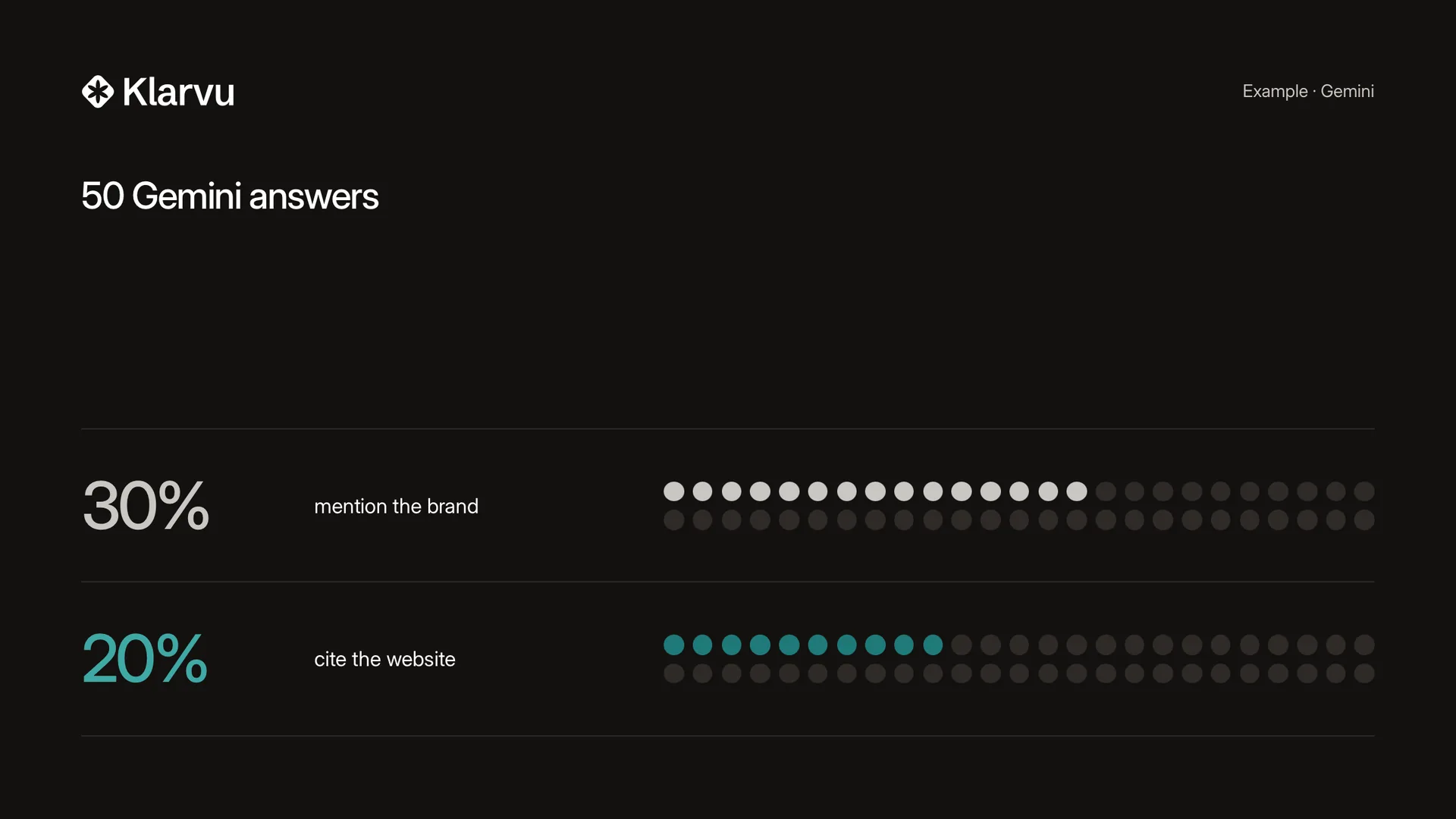
These are hypothetical numbers, not findings from Klarvu research.
The denominators matter.
If you calculate a recommendation rate from every question, including those asking for explanations rather than product suggestions, the result may be misleading.
It's also important to retain the original responses and source links.
A single number doesn't tell you whether Gemini described your company accurately, whether it recommended you to the right audience, or which competitors appeared instead.
For reliable comparisons, keep the prompts and testing conditions as consistent as possible. Document model versions, dates, languages, countries, and relevant settings.
At Klarvu, we help businesses track AI brand mentions, citations, recommendations, and competitor visibility across supported platforms, including Gemini.
This complements Google's Search Console data by focusing on what AI assistants actually say when people ask relevant questions.
What Google says you don't need to do for AI visibility
There's no shortage of advice about optimizing for generative AI.
Some suggestions are useful. Others have become popular without much supporting evidence.
In May 2026, Google published a dedicated guide to optimizing for generative AI features in Search.
One of its most interesting sections addresses common GEO misconceptions.
Google explicitly says that the following aren't required for visibility in its generative Search features:
Creating an llms.txt file just for Google Search. Google says Search doesn't use these files as a special optimization mechanism. Maintaining one for another service may still make sense, but it won't improve your Google Search rankings.
Breaking every article into tiny AI-friendly chunks. Google says its systems can understand different subjects within a webpage. There's no prescribed paragraph length or ideal page length for AI Search.
Writing a separate page for every prompt variation. Google's systems can understand related meanings and synonyms. You don't need to publish hundreds of near-identical pages to cover every conversational phrasing.
Manufacturing brand mentions. Artificial endorsements and low-quality promotional content aren't a reliable shortcut to visibility.
Using special AI schema markup. Google says no special schema.org markup is needed to appear in AI Overviews or AI Mode.
These statements concern Google's generative Search features. They shouldn't automatically be treated as documentation of how every external AI platform works.
Still, they're useful reminders.
A strong technical foundation, useful information, genuine expertise, and accurate evidence are better places to invest than tactics built around unverified ranking theories.
A practical 30-day plan for investigating Gemini visibility
Rather than changing everything at once, start with a small, documented investigation.
| Week | What to do | What you should have afterward |
|---|---|---|
| Week 1 | Check Search indexing, crawler accessibility, and relevant AI content controls. Test a consistent set of Gemini questions. | A technical audit and initial visibility baseline. |
| Week 2 | Review the most relevant webpages. Improve missing product facts, explanations, and supporting evidence. | A record of content changes tied to real questions. |
| Week 3 | Analyze competing brands and external sources. Where useful, compare related questions in Google's AI Search experiences. | A prioritized list of content and source gaps. |
| Week 4 | Repeat your Gemini tests under comparable conditions. Review Search Console's generative AI reports separately. | A first comparison and a clearer idea of what to investigate next. |
Thirty days is enough to learn where you stand.
It isn't a guarantee that your website will begin receiving more Gemini citations.
AI responses can vary between runs. Search results and model behavior can change. And a positive movement following a website update doesn't prove that the update caused it.
The value comes from building a consistent process and learning from the results.
Frequently asked questions
How do I get my website cited in Google Gemini?
Start by ensuring your website is technically accessible and that its important pages are discoverable through Google Search. Publish specific, useful, evidence-based information, maintain accurate business details, and investigate which sources and brands Gemini presents for relevant questions. No individual optimization guarantees a citation.
Does ranking on Google help with Gemini citations?
A strong Google Search presence can support discoverability, and Google's AI Search features are built on core Search systems. However, a high organic ranking doesn't guarantee a citation in the standalone Gemini app. Different products can use different retrieval processes and display different sources.
Do I need to allow Google-Extended to appear in AI Overviews?
No. Google-Extended controls certain Gemini-related training and grounding uses. It doesn't affect ordinary Google Search inclusion or rankings. AI Overviews and AI Mode follow Google's Search eligibility rules, alongside the separate Search generative AI control.
What is the Search generative AI control?
It's a Search Console setting that lets website owners manage whether their content and links may appear in supported generative AI features within Google Search. The setting covers AI Overviews, AI Mode, and generative AI features in Discover. It isn't the same as Google-Extended and doesn't control every possible mention of your company in the standalone Gemini app.
Does schema markup help Gemini cite my website?
Accurate structured data can help Google understand webpage information and support applicable Search features. However, Google hasn't published a special schema type that guarantees Gemini citations. The most useful approach is to implement relevant structured data correctly and keep it consistent with the visible content.
Does Gemini always show sources?
No. Gemini can display sources and related links, but some responses don't include them. Also, links surfaced by a separate verification or double-checking process aren't necessarily sources used to generate the original answer. If you're tracking citations, define clearly which links you're counting.
Can Google Search Console track Gemini recommendations?
Not directly. Search Console's Generative AI performance reports cover supported AI experiences in Google Search and Discover. They don't provide a complete prompt-by-prompt record of brand mentions and recommendations in the standalone Gemini app.
How long does it take to improve Gemini visibility?
There is no reliable universal timeframe. Visibility depends on the question, available sources, website accessibility, model behavior, and competition. Monitor patterns across repeated tests rather than assuming one website change will produce immediate results.
Start by comparing what Google knows with what Gemini says
Choose five questions your potential customers might realistically ask Gemini.
Look at the answers. Which companies are mentioned? Which are recommended? What sources appear? Is your own product described correctly?
Then examine the same subjects in Google Search.
You may find that your website is easy to discover through traditional search but rarely appears in Gemini's recommendations.
Or you may discover that independent publishers are providing most of the information Gemini associates with your product category.
Either observation gives you something concrete to investigate.
Your next improvement might be clearer product documentation, a relevant external reference, or a piece of original research.
The useful starting point is understanding which problem you're actually trying to solve.
For the other platforms, see our guides to getting cited in ChatGPT, Claude, and Perplexity.
Sources and further reading
- Google Search Central: AI features and your website
- Google Search Central: Optimizing for generative AI features on Google Search
- Google: List of common crawlers and Google-Extended
- Google Search Console Help: Search generative AI control
- Google Search Central: Generative AI performance reports
- Google Gemini Help: View related sources and double-check responses